Serving All North Carolina
(704) 954-8697
Charlotte Maximum Medical Improvement Lawyer
Maximum medical improvement is one of the most consequential milestones in any North Carolina workers’ comp case. It affects your benefits, your ability to return to work, and the long-term value of your claim.
Understanding what MMI means and what comes next is critical for any injured worker in Charlotte.
At Waple & Houk, PLLC, our Charlotte workers’ compensation lawyers help workers navigate the maximum medical improvement process. We make sure our clients understand their rights before signing anything, before returning to work, and before accepting any settlement. Contact us for a free case review.
What Is Maximum Medical Improvement (MMI)?
Maximum medical improvement is a medical and legal benchmark determined by your treating physician. Reaching MMI means you have improved as much as is medically possible for your specific workplace injury. It does not mean you are fully healed or that you have returned to your pre-injury condition. It means that continuing treatment would produce no further meaningful improvement.
Once your doctor makes this determination, it triggers a series of important steps in your workers’ comp case. Your employer will likely begin pressing you to return to work. Your insurance carrier will begin looking to limit or discontinue treatment-related comp benefits.
This is one of the most important points in your claim. A Charlotte maximum medical improvement lawyer can help protect your rights at this stage and make sure the determination is accurate and fairly applied.
What Does Maximum Medical Improvement Mean for Your Workers’ Comp Benefits?
Reaching MMI does not end your workers’ comp case. It changes it. Once the determination is made, several things happen:
- Your treating physician will assess whether you have any permanent disability impairment
- You or your attorney will request a Permanent Partial Disability (PPD) rating
- Your physician will outline any permanent work restrictions
- Your employer may ask you to return to work or offer modified duty
- Your insurance carrier may move to discontinue treatment benefits
How these steps unfold directly affects the compensation benefits you receive. Having a skilled lawyer at this stage helps ensure the process works in your favor, not your employer’s.
MMI Maximum Medical Improvement and the PPD Rating
After reaching the maximum medical improvement threshold, your physician will assign a Permanent Partial Disability rating if your injury left you with lasting physical limitations. This PPD rating is expressed as a percentage. It reflects the degree to which a specific body part or function no longer works normally.
A rating of 0% means no permanent disability was found. A rating of 100% means the body part or function is completely non-functional. Most workers receive a rating somewhere between these extremes.
The PPD rating determines how long you receive disability comp payments and at what amount. Under North Carolina workers’ compensation law, benefits are calculated at two-thirds of your average weekly wage. The number of weeks depends on which body part was injured and the assigned percentage.
Importantly, receiving PPD payments does not prevent you from returning to work. These payments compensate for the permanent loss of function, not just lost wages. You can return to work and continue receiving PPD workers’ comp benefits at the same time.
MMI Rating Scale in North Carolina Workers’ Compensation
North Carolina workers’ comp uses a body part schedule to translate your maximum medical improvement rating into a specific number of benefit weeks. This is sometimes called the MMI rating scale or the workers’ comp rating chart.
The schedule is set by statute under the North Carolina Workers’ Compensation Act. Your disability percentage is multiplied by the scheduled weeks for that body part to calculate your total comp benefit weeks. A few examples from the schedule:
| Body Part | Maximum Scheduled Weeks (100% loss) |
| Thumb | 75 weeks |
| Index finger | 45 weeks |
| Hand | 200 weeks |
| Arm | 240 weeks |
| Foot | 144 weeks |
| Leg | 200 weeks |
| Eye | 120 weeks |
| Hearing (one ear) | 70 weeks |
| Back | 300 weeks |
For example, a 20% rating for a back injury results in 60 weeks of PPD benefits (20% of 300 weeks). Injuries to the spine, brain, or other unlisted body parts may be handled differently and require careful legal and medical analysis.
The maximum medical improvement workers’ compensation calculation can be complex. Insurers sometimes use a low rating to minimize the comp benefits you receive. A Charlotte MMI attorney can evaluate whether your rating accurately reflects your workplace injuries.
Who Determines When You Have Reached MMI?
Your treating physician makes the determination. A doctor will only conclude that maximum medical improvement has been reached after exhausting all available treatment options. They must find that further treatment would produce no meaningful improvement in your condition.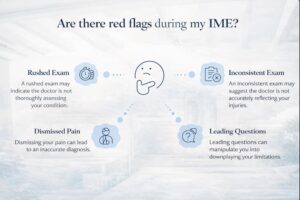
There is an important complication. The insurance carrier may also order an independent medical examination. The examining physician is paid by the insurer and may reach a different conclusion than your treating doctor. These opinions sometimes favor an earlier determination, which can shorten your benefit period and limit your workers’ comp claim.
If the independent exam conflicts with your treating physician’s findings, you have the right to challenge it. A maximum medical improvement lawyer can help you navigate a disputed determination and protect the full timeline of your comp benefits.
Does Medical Treatment Continue After Reaching MMI?
Reaching MMI does not automatically end all medical treatment. Many workers continue to need ongoing care even after their condition has stabilized. Those with serious injuries may require regular screenings, pain management, or care for partial disabilities for the rest of their lives.
What changes is the nature of the treatment. Active care aimed at improvement typically ends. Ongoing maintenance care may continue and can still be covered under your workers’ comp claim depending on the circumstances and the nature of your injuries.
Whether future medical care is covered and for how long is often a point of dispute between workers and insurance carriers. Waple & Houk, PLLC negotiates these terms on behalf of our clients to protect ongoing access to care. Contact our office early to preserve your options.
What Happens if You Cannot Return to Work After MMI?
This is one of the most difficult situations a worker can face. Reaching MMI does not mean you are able to return to your previous job. It only means that treatment will not improve your condition further.
When you receive your PPD report, your physician will also document any permanent work restrictions. These restrictions may prevent you from returning to your former occupation entirely. Your disability percentage and your work restrictions are two separate things. It is possible to have a low percentage but severe enough restrictions that your previous job is no longer viable.
In an ideal situation, your employer works with you to find modified duties you can perform. When that is not possible, your injury lawyer negotiates a settlement that accounts for your restrictions, your disability rating, your lost earning capacity, and your ongoing medical needs.
We strongly recommend that workers not sign any Award Agreement Form until they have returned to work for at least three months. This gives you time to assess whether you can actually perform the required duties. If you cannot, your physician may need to reassess your restrictions before any agreement is finalized.
Maximum Medical Improvement MMI North Carolina Workers Compensation: What Charlotte Workers Need to Know
North Carolina workers’ compensation law governs every aspect of the maximum medical improvement process. The Workers’ Compensation Act sets the schedule of comp benefits, the process for disputing a determination, and the rights workers have at each stage.
Charlotte workers should know:
- You have the right to challenge an independent exam opinion that conflicts with your treating doctor
- You have the right to request a second opinion before accepting a determination
- Your employer cannot force you to return to work before you are medically cleared
- Signing a settlement after MMI is often permanent and difficult to reopen
- An attorney can negotiate the terms of your PPD workers’ comp settlement before you sign anything
The period following a maximum medical improvement determination is often when insurance carriers apply the most pressure on workers’ claims. They want a quick settlement at a low number. Having Waple & Houk, PLLC at this stage gives you the best opportunity to secure a fair outcome for your workplace injuries.
Frequently Asked Questions About MMI and Workers’ Comp
What does maximum medical improvement mean in workers’ compensation?
Maximum medical improvement means your treating physician has determined that your work injury has stabilized. Further medical treatment will not produce meaningful improvement. It does not mean you are fully recovered. It is a legal and medical benchmark that triggers the PPD rating process and affects the next phase of your workers’ comp benefits.
What is the MMI rating scale in North Carolina?
The MMI rating scale in North Carolina is a body part schedule set by the Workers’ Compensation Act. It assigns a maximum number of comp weeks to each body part based on total loss of function. Your disability percentage is multiplied by the scheduled weeks for your affected body part to calculate your total benefit weeks. For example, a 20% rating for a back injury equals 60 weeks of PPD comp benefits based on the 300-week back schedule.
What happens to my workers’ comp benefits after MMI?
After reaching MMI, treatment-related comp benefits typically transition to PPD payments based on your disability rating. Ongoing medical maintenance may still be covered depending on your injuries. Your employer may ask you to return to work. If you have permanent restrictions that prevent you from doing so, your attorney can negotiate a workers’ comp settlement that accounts for your long-term limitations and lost earning capacity.
Can I dispute an MMI determination in North Carolina?
Yes. If the insurance carrier’s independent examiner reaches an earlier conclusion than your treating physician, you have the right to challenge that finding. You can also request a second opinion from another doctor. A workers’ compensation attorney can help you dispute the determination through the North Carolina Industrial Commission process.
Contact Our Charlotte Maximum Medical Improvement Attorneys
Reaching MMI is not the end of your workers’ comp case. It is one of its most important turning points. The decisions made at this stage affect your PPD rating, your settlement value, your return-to-work options, and your access to future medical care for your workplace injuries.
Waple & Houk, PLLC is here to make sure you understand your rights before any decisions are finalized. We serve workers throughout Charlotte and Mecklenburg County. We handle workers’ compensation cases at every stage, including maximum medical improvement determinations, PPD ratings, and settlement negotiations.
Contact us today for a free case review and a clear explanation of what your determination means for your claim.
Workers’ Compensation
And Family Lawyers
Providing
Strength In A
Time of Crisis
Call US now:





reviews
What Real Clients Have To Say
Melissa S.

Lou and his team did an outstanding job on my case. They kept me updated constantly. There were times when I was so overwhelmed-the encouragement I received from the firm is the BEST I’ve received from any law firm in the past. I HIGHLY recommend Lou and his team.
Tim J.
Great attorney helped the most at a important time.
Aimee B.
Lou and his team worked quickly to ensure that my husband received the care and physical therapy he needed after a pretty serious work injury. They handled every phone call and question with the insurance adjuster, we didn’t have to fight with anyone to get anything that was expected or promised. They communicated with us every step of the way, and they were especially responsive and helpful when my husband’s case required more than anyone had anticipated. Every person we have spoken with in Lou’s office were patient and respectful, we never felt like we...
Lucas J.
Very good people to work with! I highly recommend this law firm.
Dustin M.
I have never had a more pleasant experience with an attorney and their paralegals in my life!!! Hands down the best law firm in North Carolina, probably the whole country! Would definitely recommend them to anyone needing counsel. They are all so easy to get along with and friendly.... My employer lied, as many do in this situation but Lou and his team were quick to step in and get me the compensation I deserved! Thank you, from my whole family. Waple and Houk are #1
Darrin R.
Mr. Lou is by far the most compassionate attorney I’ve encountered and once again he helped me with a worker’s compensation claim and his paralegal was also great. Mr.Lou is very professional and he allows you room for your concerns and opinions, he’s just a great human being that doesn’t need to advertise his partnership law firm on tv just ask any of his past clients and they would totally agree with me, God forbid that I’m in a serious car accident but if I am he’s just a phone call away so if you...
Travis B.
Mr. Waple did a fantastic job on my case, even if I wasn't a lot of help he still came through and for that I thank you Mr. Waple.
Tara D.
I was at a point of despair & thought that my then employer would do the right thing. Lou’s honesty, and integrity; along with his guidance gave me the dose of reality that I needed to see the true colors of legality in corporate America. Without his savvy I would have been blindsided! Cherie, always responded to all of my responses, and nervous reactions and made sure Lou was aware of what was happening! Great firm, I would highly recommend to anyone who wants respect, honesty and guidance as a client!
Aunyette S.
Mr.Waple has handled both of my cases very well. I definitely recommend this team of professional lawyers and secretaries. Thank you!
Tashaun H.
My experience working with Lou was an absolute joy. From our very first conversation, he assured me that he would work relentlessly to help me secure adequate compensation for my case and he did just that. His paralegal, Cheri, was helpful with timely responses to any and all questions I had and she helped reduce the stress of a very tedious process. I highly recommend this firm for any future litigation and would love to work with them again if the opportunity arises.