Serving All North Carolina
(704) 954-8697
Charlotte Workers’ Compensation Lawyer
Legally Reviewed by Workers’ Compensation Attorney Lou Waple
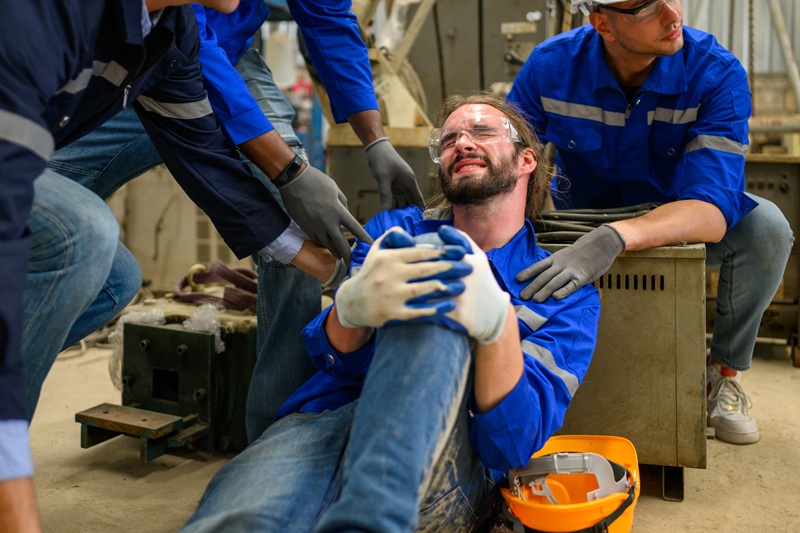
Getting hurt at work can quickly create questions about medical treatment, lost wages, and what your employer’s insurance company will cover. At the same time, you may be expected to report the injury, follow claim procedures, and make decisions that can affect your benefits.
Waple & Houk, PLLC represents injured workers throughout Charlotte and Mecklenburg County. Attorney Lou Waple previously represented insurance companies and employers in workers’ compensation matters before dedicating his practice to injured workers. That experience gives our firm insight into how insurers evaluate, defend, and dispute claims.
Whether your claim has just begun or you are already facing problems with the insurance carrier, our attorneys can help you understand your rights and pursue the workers’ compensation benefits available under North Carolina law.
Contact Waple & Houk to schedule a free consultation about your workplace injury.
Hurt at Work in Charlotte?
Talk with our workers’ compensation team about your injury and the next steps in your claim.
Discuss Your ClaimOur Workers’ Compensation Results for Charlotte Clients
Waple & Houk has represented injured workers in claims involving serious back, shoulder, neck, hip, hand, and foot injuries. Results include:

- $325,000 — Back injury compensation
- $198,000 — Back injury compensation
- $170,000 — Shoulder injury compensation
- $130,000 — Shoulder injury compensation
- $125,000 — Back injury compensation
- $115,000 — Back/hip injury compensation
- $100,000 — Foot injury compensation
- $90,000 — Neck/back injury compensation
- $75,000 — Hand injury compensation
- $70,000 — Foot injury compensation
Past results do not guarantee future outcomes. Every case is different.
What Is Workers’ Compensation in North Carolina?
Workers’ compensation provides benefits to eligible employees who suffer work-related injuries or occupational illnesses. North Carolina generally requires businesses with three or more employees to carry workers’ compensation insurance.

The system is generally no-fault, meaning an injured employee usually does not need to prove that the employer caused the accident. However, an injury must meet North Carolina’s requirements for a compensable workers’ compensation claim. Not every injury that happens at work automatically qualifies.
Depending on the claim, workers’ compensation may provide medical treatment, partial wage replacement, and other benefits related to the injury. Disputes can arise over whether an injury is covered, what treatment is authorized, when an employee can return to work, or what benefits should be paid.
Waple & Houk helps injured workers understand these issues and deal with the insurance carrier throughout the claims process.
Charlotte Workers We Represent
Workplace injuries can happen in nearly any occupation. Waple & Houk, PLLC, represents workers throughout Charlotte and Mecklenburg County, including employees in some of the region’s largest industries.

- Warehouse and distribution workers — Lifting injuries, forklift accidents, falls, repetitive-motion injuries, and other hazards can affect employees working in warehouses and distribution centers.
- Construction workers — Falls, equipment accidents, struck-by incidents, and other serious injuries can occur on construction sites.
- Healthcare workers — Nurses, technicians, aides, and other healthcare employees can suffer injuries while lifting patients, handling equipment, or performing physically demanding work.
- Truck drivers and delivery drivers — Drivers can face injuries from vehicle crashes, loading and unloading cargo, lifting packages, and repeated physical demands.
- Manufacturing workers — Machinery, repetitive tasks, lifting, falls, and other workplace hazards can result in serious injuries.
- Retail workers — Employees can suffer lifting injuries, falls, repetitive-motion injuries, and other work-related injuries while stocking merchandise, working in storage areas, or assisting customers.
- Restaurant and food service workers — Kitchen staff, servers, and other food service employees can face burns, cuts, falls, lifting injuries, and other workplace hazards.
- Office and corporate employees — Work-related injuries are not limited to physically demanding occupations. Office employees may also develop repetitive-motion injuries or suffer other injuries connected to their employment.
The circumstances surrounding an injury matter more than the employee’s job title. Our Charlotte workers’ compensation attorneys evaluate how the injury occurred, how it affects the employee’s ability to work, and what benefits may be available under North Carolina law.
Can You Qualify for Workers’ Compensation in Less Obvious Situations?

Not every workers’ compensation claim involves a sudden accident with an obvious injury. Coverage can become more complicated when a condition develops over time, involves a prior injury, occurs away from the usual workplace, or raises questions about employment status.
Occupational Diseases and Conditions That Develop Over Time
Some work-related conditions may qualify as occupational diseases even without a single accident date. However, simply developing pain or a medical condition while working does not automatically make it compensable.
North Carolina applies specific requirements to occupational disease claims. Establishing the connection between the condition and the employee’s work can require medical evidence and a detailed understanding of job duties and workplace exposure.
Pre-Existing Conditions Aggravated by Work
Having a pre-existing condition does not automatically prevent an employee from receiving workers’ compensation benefits. A new workplace accident may aggravate or accelerate an existing condition and create a compensable claim.
These cases often depend heavily on medical records and evidence connecting the employee’s current condition to the workplace injury. Waple & Houk helps clients address disputes involving prior injuries and pre-existing medical conditions.
Injuries Away From Your Usual Worksite
Workers’ compensation coverage is not necessarily limited to accidents that happen inside your regular workplace. Injuries during required training, work-related travel, or other employment activities may qualify depending on the circumstances.
Parking-lot injuries, breaks, travel, and other less straightforward situations can involve additional legal questions. An employer’s initial position does not necessarily determine whether a claim is compensable under North Carolina law.

Independent Contractors and Employee Misclassification
Being classified as an independent contractor does not necessarily resolve whether you are eligible for workers’ compensation. North Carolina looks beyond the label used by the employer and considers the actual working relationship.
If your employment status is disputed after an injury, a workers’ compensation attorney can evaluate the circumstances and whether you may qualify as an employee under North Carolina law.
What Workers’ Compensation Benefits Are Available in North Carolina?
Depending on the injury and its effect on your ability to work, North Carolina workers’ compensation may provide several types of benefits:
- Medical benefits — Covered treatment may include physician visits, hospitalization, surgery, physical therapy, prescriptions, and other care reasonably required to address a compensable injury.
- Temporary total disability (TTD) — Eligible workers who are unable to work may receive wage-replacement benefits generally based on two-thirds of their average weekly wage, subject to statutory limits and other requirements.
- Temporary partial disability (TPD) — Benefits may be available when an injured employee returns to work but earns less because of the injury.
- Permanent partial disability (PPD) — A worker with permanent impairment to certain body parts may qualify for compensation based on the impairment rating and statutory schedule.
- Vocational rehabilitation — In appropriate cases, vocational assistance may help an injured employee return to suitable employment.
- Death benefits — Certain dependents may qualify for benefits following a compensable workplace death.
The benefits available depend on the circumstances of the injury, medical evidence, earnings, and ability to return to work.
What Does Maximum Medical Improvement Mean?
Maximum medical improvement (MMI) generally means a worker’s condition has stabilized and further substantial improvement is not expected. Reaching MMI can affect how the claim is evaluated, including whether there is a permanent impairment.
MMI does not necessarily mean that all workers’ compensation benefits immediately end. The effect depends on the worker’s medical condition, work restrictions, earning capacity, and other circumstances.

How Does the North Carolina Workers’ Compensation Claims Process Work?
A North Carolina workers’ compensation claim involves several reporting and filing requirements. Taking the right steps early can help protect your ability to pursue benefits.
Report the injury promptly. Injured employees generally should provide written notice to their employer within 30 days. There are exceptions to this requirement, but reporting the injury as soon as possible can help avoid unnecessary disputes.
Make sure the claim is properly filed. Employers have reporting obligations for qualifying workplace injuries, including filing Form 19 with the North Carolina Industrial Commission. Injured workers generally use Form 18 to provide notice of the accident and claim benefits.
Get appropriate medical treatment. Medical records can become important evidence of the injury, treatment, work restrictions, and relationship between the condition and employment.
The carrier reviews the claim. The insurance company may accept the claim, deny it, or dispute particular benefits or treatment. Waple & Houk helps injured workers navigate this process, communicate with the carrier, and address problems that arise during the claim.
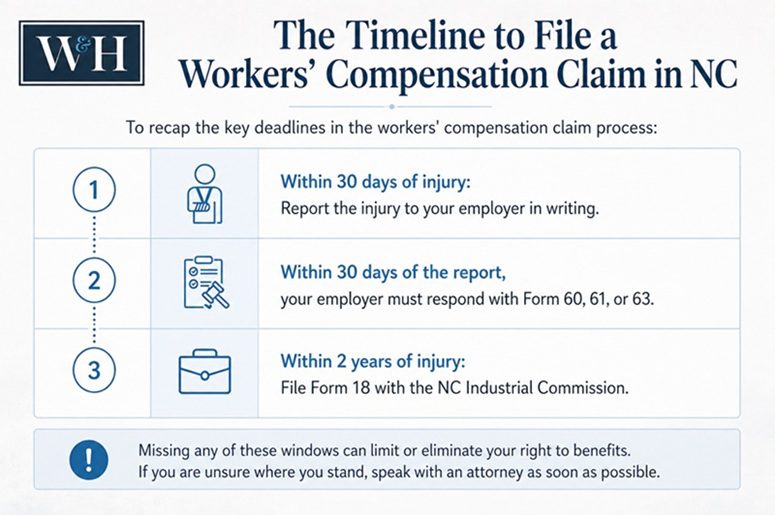
Workers’ compensation deadlines can vary depending on the claim and circumstances. If you are unsure whether a notice or filing deadline applies, getting legal guidance early can help protect your rights.
What Can You Do If Your Workers’ Compensation Claim Is Denied?
A denial does not necessarily mean your workers’ compensation case is over. Claims can be disputed for many reasons, including questions about how an injury occurred, whether it is work-related, employment status, medical evidence, or reporting requirements.
An injured worker may be able to challenge the denial through the North Carolina Industrial Commission. Depending on the dispute, the process can involve mediation and a hearing before a deputy commissioner.
Waple & Houk represents injured workers in workers’ compensation disputes and denied claims. We review the reason for the denial, identify the evidence needed to address it, and represent clients throughout the dispute process.
Questions About Your Workers’ Comp Claim?
Get clear guidance on medical treatment, wage benefits, claim disputes, and what comes next.
Get Started TodayWhy Charlotte Injured Workers Choose Waple & Houk

Workers’ compensation is a significant part of our practice at Waple & Houk, PLLC. Our attorneys understand both the legal requirements of a claim and the practical challenges injured workers can encounter when dealing with employers and insurance carriers.
Experience on Both Sides of Workers’ Compensation Claims
Attorney Lou Waple has more than 20 years of experience handling workers’ compensation matters. Before representing injured workers, he represented employers and insurance companies.
That background gives him firsthand knowledge of how carriers evaluate claims, investigate injuries, review medical evidence, and defend disputed cases. He now uses that experience to advocate for injured workers throughout Charlotte and Mecklenburg County.
Recognized Workers’ Compensation Experience
Lou’s professional recognition includes being named one of Charlotte’s Best Workers’ Compensation Lawyers by Expertise.com in 2026, recognition by the National Trial Lawyers Top 100, and selection as an Elite Lawyer in Workers’ Compensation in 2025.
Direct Access to Your Attorney
At Waple & Houk, clients communicate directly with the attorney handling their workers’ compensation case. You are not left relying solely on a case manager or passing important questions through multiple layers of staff.
That direct relationship helps our attorneys understand how the injury is affecting your work, medical treatment, and daily life as the claim develops.
What Our Clients Say
“My employer lied, as many do in this situation, but Lou and his team were quick to step in and get me the compensation I deserved. I have never had a more pleasant experience with an attorney and their paralegals in my life. Hands down the best law firm in North Carolina.”
— Dustin M., Verified Google Review
“Lou’s honesty and integrity, along with his guidance, gave me the dose of reality I needed to see the true colors of legality in corporate America. Without his savvy I would have been blindsided. Great firm — I would highly recommend to anyone who wants respect, honesty, and guidance as a client.”
— Tara D., Verified Google Review
Common Questions About Workers’ Compensation in Charlotte
Can my employer fire me for filing a workers’ comp claim?
North Carolina law prohibits employers from retaliating against employees for filing or pursuing a workers’ compensation claim. Prohibited retaliation can include termination, demotion, or other adverse employment actions because an employee exercised protected rights.
However, filing a claim does not prevent an employer from taking action for legitimate, unrelated reasons. If you believe you were fired or otherwise penalized because of your workers’ compensation claim, speak with an attorney promptly because separate deadlines may apply.
How long do I have to file a workers’ compensation claim in North Carolina?
In many cases, an injured worker must provide written notice of a workplace accident to the employer within 30 days and file a claim with the North Carolina Industrial Commission within two years of the injury.
Exceptions and different rules can apply depending on the circumstances, including certain occupational disease claims. Because workers’ compensation deadlines can affect your ability to receive benefits, it is better to address a claim as soon as possible.

Does my employment status affect workers’ compensation eligibility?
Yes. Employment status can affect whether North Carolina workers’ compensation law covers an injury, but job title or work arrangement alone does not always determine eligibility.
Part-time, temporary, seasonal, and newly hired employees may be covered when the employer and employment relationship fall within the Workers’ Compensation Act. Independent contractor status can require closer examination because the label used by an employer does not necessarily determine whether a worker is legally an employee.
If there is a dispute over your employment status, Waple & Houk can review the actual working relationship and circumstances of your injury.
How much does it cost to hire a Charlotte workers’ compensation attorney?
Waple & Houk handles workers’ compensation cases on a contingency-fee basis, meaning attorney fees are generally tied to compensation obtained rather than charged as an upfront hourly fee.
Workers’ compensation attorney fees in North Carolina are also subject to approval by the North Carolina Industrial Commission. Waple & Houk explains the fee arrangement before representation begins so you understand how attorney fees and potential case expenses will be handled.
Recommended Reading
Learn more about your rights as an injured worker in North Carolina:
- North Carolina Workers’ Compensation Laws — A plain-language overview of how the state system works, who is covered, and what the law requires of employers.
- Compensable Injuries in Workers’ Compensation Claims — Not sure if your injury qualifies? This guide covers what North Carolina law recognizes as a covered work injury.
- How to File a Workers’ Compensation Claim — Step-by-step guidance on the filing process, the forms involved, and the deadlines that matter most.
- Do I Really Need a Lawyer for My Workers’ Compensation Claim in Charlotte? — An honest look at when hiring an attorney makes a material difference to your outcome.
Talk to a Charlotte Workers’ Compensation Lawyer

A workplace injury can affect your health, your income, and your ability to support yourself while you recover. You do not have to navigate the workers’ compensation process or deal with the insurance carrier on your own.
Waple & Houk, PLLC offers free consultations to injured workers in Charlotte and throughout Mecklenburg County. We can review your situation, explain your rights under North Carolina law, and help you understand the next steps available in your claim.
Our Charlotte office is located at 1212 Kenilworth Ave, Charlotte, NC 28204, across from Atrium Health Carolinas Medical Center. We represent injured workers throughout Charlotte and Mecklenburg County.
Contact Waple & Houk to schedule a free consultation with a Charlotte workers’ compensation lawyer.
Get Help With Your Workers’ Compensation Claim
If a workplace injury has left you dealing with medical care, missed work, or an insurance dispute, Waple & Houk can help you understand your options.
Schedule Your ConsultationWorkers’ Compensation
And Family Lawyers
Providing
Strength In A
Time of Crisis
Call US now:





reviews
What Real Clients Have To Say
Melissa S.

Lou and his team did an outstanding job on my case. They kept me updated constantly. There were times when I was so overwhelmed-the encouragement I received from the firm is the BEST I’ve received from any law firm in the past. I HIGHLY recommend Lou and his team.
Tim J.
Great attorney helped the most at a important time.
Aimee B.
Lou and his team worked quickly to ensure that my husband received the care and physical therapy he needed after a pretty serious work injury. They handled every phone call and question with the insurance adjuster, we didn’t have to fight with anyone to get anything that was expected or promised. They communicated with us every step of the way, and they were especially responsive and helpful when my husband’s case required more than anyone had anticipated. Every person we have spoken with in Lou’s office were patient and respectful, we never felt like we...
Lucas J.
Very good people to work with! I highly recommend this law firm.
Dustin M.
I have never had a more pleasant experience with an attorney and their paralegals in my life!!! Hands down the best law firm in North Carolina, probably the whole country! Would definitely recommend them to anyone needing counsel. They are all so easy to get along with and friendly.... My employer lied, as many do in this situation but Lou and his team were quick to step in and get me the compensation I deserved! Thank you, from my whole family. Waple and Houk are #1
Darrin R.
Mr. Lou is by far the most compassionate attorney I’ve encountered and once again he helped me with a worker’s compensation claim and his paralegal was also great. Mr.Lou is very professional and he allows you room for your concerns and opinions, he’s just a great human being that doesn’t need to advertise his partnership law firm on tv just ask any of his past clients and they would totally agree with me, God forbid that I’m in a serious car accident but if I am he’s just a phone call away so if you...
Travis B.
Mr. Waple did a fantastic job on my case, even if I wasn't a lot of help he still came through and for that I thank you Mr. Waple.
Tara D.
I was at a point of despair & thought that my then employer would do the right thing. Lou’s honesty, and integrity; along with his guidance gave me the dose of reality that I needed to see the true colors of legality in corporate America. Without his savvy I would have been blindsided! Cherie, always responded to all of my responses, and nervous reactions and made sure Lou was aware of what was happening! Great firm, I would highly recommend to anyone who wants respect, honesty and guidance as a client!
Aunyette S.
Mr.Waple has handled both of my cases very well. I definitely recommend this team of professional lawyers and secretaries. Thank you!
Tashaun H.
My experience working with Lou was an absolute joy. From our very first conversation, he assured me that he would work relentlessly to help me secure adequate compensation for my case and he did just that. His paralegal, Cheri, was helpful with timely responses to any and all questions I had and she helped reduce the stress of a very tedious process. I highly recommend this firm for any future litigation and would love to work with them again if the opportunity arises.