Serving All North Carolina
(704) 954-8697
Does Workers’ Comp Cover Remote Workers in Charlotte, NC?
Connect With Us
15Nov
If you were injured while working from home and the injury is connected to your job duties, North

Carolina workers’ compensation can cover you. What matters is whether the injury happened in the course of your employment. If you got hurt while doing something for your job and are unsure whether it counts, speaking with a Charlotte workers’ compensation lawyer is the fastest way to get a clear answer about your case.
Charlotte has one of the highest concentrations of remote workers in the country. A 2025 study found that roughly 150,000 Charlotte workers, about 29.7% of the local workforce, worked remotely, placing the city third nationally. That is a large number of people who may not fully understand their rights when a work injury occurs away from a traditional job site.
Remote Workers and NC Workers’ Compensation
North Carolina does not have a separate rulebook for remote workplace injuries. The same standard that applies to office workers applies to employees working from home. Under state law, a compensable injury must arise out of and in the course of employment. That standard holds whether you work in an Uptown office tower or at a desk in NoDa.
In practice, your home becomes a secondary workplace when you are on the clock. Injuries that happen there during job-related activity are treated the same as injuries on a traditional job site.
The Two-Part Test NC Uses for Compensation Benefits
To qualify for workers’ comp benefits as a remote employee, your injury generally needs to satisfy both parts of this test:
- Arose out of employment: The injury was caused by a risk connected to your job, not just a general hazard of being at home.
- In the course of employment: The injury happened while you were performing your job duties or something closely tied to them.
Both parts must be met. A slip in your kitchen during a lunch break is a different case from a trip over a power cord during a video call. The facts of each situation determine what compensation applies.
Remote and Off-Site Employees Can Still Qualify for Workers’ Comp
Remote work is not limited to employees sitting at home behind a laptop. Delivery drivers, field technicians, and other employees who work away from a traditional office or job site may still qualify for benefits after a work-related injury.
One of the biggest issues in these cases is whether the employee was performing job-related duties at the time of the accident. Employers and insurance companies sometimes argue that travel-related injuries fall outside compensation coverage, especially when the employee works independently or spends most of the day off-site. The details of where the worker was going, what task they were performing, and whether the activity benefited the employer can all become part of the claim review process.
Common claims involving remote and field employees include:
- Car accidents during deliveries or work-related travel
- Slip and fall accidents at customer locations or job sites
- Loading and unloading injuries affecting the back, neck, or shoulders
- Accidents caused by third parties while on the clock
- Delivery and transportation-related injuries during a work route
Many injured workers assume they are not covered because they were not inside a traditional workplace when the accident happened. In reality, North Carolina workers’ compensation laws still protect employees whose jobs take place on the road or in the field.
What Compensation Benefits Can You Recover?
North Carolina workers’ compensation covers several categories of losses when a compensable injury is established. Understanding what is available helps you evaluate whether to pursue a case.
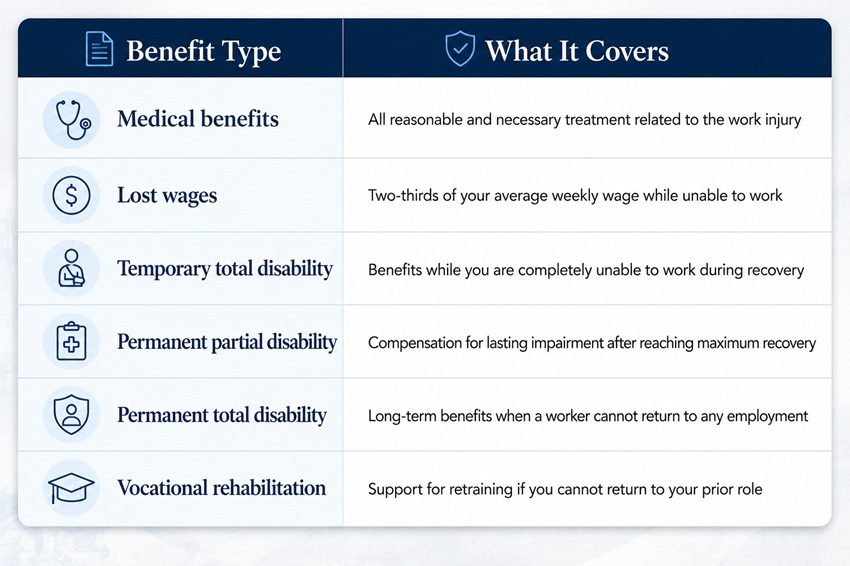
Lost wages and disability benefits are among the most significant for injured remote workers. If your injuries keep you out of work for an extended period, those benefits become a financial lifeline. Temporary and permanent disability payments are calculated based on your average weekly wages before the accident. Do not leave compensation on the table by assuming you do not qualify.
If you work remotely and were injured while performing job-related duties from home, do not assume your claim is automatically excluded from workers’ compensation coverage. Remote work injury claims often depend on the specific facts surrounding the accident and whether the activity was connected to your job responsibilities. An attorney can evaluate your situation, explain what benefits may apply, and help you pursue a claim supported by the right evidence.
What Does Not Count as a Compensable Work Injury
Not every injury that happens during work hours qualifies. North Carolina draws a line between injuries tied to job duties and those that are purely personal or domestic in nature.
Common examples that typically fall outside coverage include:
- Injuries during personal tasks, even if they occur during work hours
- Accidents during lunch or breaks with no connection to a work task
- Injuries from pre-existing home conditions unrelated to your work setup
- Falls in areas of the home with no connection to your designated workspace
- Car accidents that occur during a personal errand, not a work-related trip
If your job was not benefiting from what you were doing at the moment of the accident, that weakens your case considerably. This is one of the more contested areas of remote work claims in North Carolina, and it is worth getting legal input before assuming you are not covered.
Does NC Law Require Workers’ Compensation for Remote Employees?
Yes. North Carolina requires any business with three or more employees to carry workers’ compensation coverage. That requirement does not change based on where employees work. A fully remote operation with a team of four people in the Charlotte area must carry the same coverage as any traditional office.
There are narrow exceptions, but remote work is not one of them. The exceptions involve specific categories like certain agricultural workers and domestic household employees. They do not apply to standard remote or field roles.
What If My Job Calls Me an Independent Contractor?
This situation deserves careful attention. Some businesses misclassify employees as independent contractors to avoid providing workers’ compensation coverage. North Carolina law looks at the actual working arrangement, not just the label on a contract.

Factors like whether your employer controls your hours, provides your tools, sets your routes, or directs your work all weigh into whether you are truly an independent contractor or a misclassified employee. Delivery drivers’ arrangements in particular are frequently contested. If the facts suggest you are an employee, you may still be entitled to compensation benefits regardless of what your paperwork says. Employers found to have misclassified workers can face serious penalties under state law, and injured workers in those situations may still have a valid claim.
Steps to Take After an Off-Site Accident or Work Injury
Following these steps after a remote work injury helps protect your ability to file a workers’ compensation claim in North Carolina and preserves your right to full compensation benefits.
- Report the injury to your employer. You have 30 days to notify your employer. Do it in writing. An email creates a record and works just as well as a formal letter. Do not rely on a verbal conversation alone.
- Get medical treatment. Be evaluated as soon as possible. Delays can be used to question the severity or work-relatedness of your injuries, and your employer’s insurance carrier will look for any gap in treatment.
- Document the scene. Take photos of your workspace or the accident location, save relevant communications, and write down what happened and when. For truck and delivery accidents, note road conditions, vehicle positions, and any witnesses.
- Keep all medical records and bills. Hold onto every receipt, prescription record, and treatment note. Lost wages calculations depend on accurate documentation of time missed from work.
- File with the NC Industrial Commission. Your claim should be submitted to the North Carolina Industrial Commission, the state agency that administers workers’ compensation claims.
Missing the 30-day reporting window can bar you from receiving benefits entirely. If you are unsure whether your injuries qualify or whether you reported in time, do not wait to get guidance.
Getting Help With a Disputed Remote Work Injury Claim
You do not need an attorney for every claim, but remote work claims come with added complexity. Insurers sometimes push back harder on these because the circumstances are harder to verify independently. When a workers’ comp claim is denied, delayed, or disputed, having an attorney changes the outcome.
Consider getting legal help if any of these apply:
- Your claim was denied by your employer
- You were told your remote status disqualifies you from coverage
- Your employer is improperly classifying you as an independent contractor
- You are dealing with a disability that affects your ability to return to work
- Your workers’ compensation case is in dispute, and you are facing a hearing before the Industrial Commission
- You are unsure whether your employer carried the required coverage at the time of your accident
North Carolina ranked second in the nation for remote work job searches between April 2024 and March 2025, according to a 2026 study reported by WWAY. As remote and delivery work stay embedded in the local economy, these cases are becoming more common. Knowing your rights now puts you in a stronger position if something goes wrong.
Our team has spent decades helping injured workers in Charlotte navigate the workers’ compensation system. If you were hurt while working remotely or out in the field, schedule a free consultation and find out where your case stands.
Workers’ Compensation
And Family Lawyers
Providing
Strength In A
Time of Crisis
Call US now:
Our Success
Case Results
$80,000
Elbow Injury
$350,000
Arm Injury
Related Posts


reviews
What Real Clients Have To Say
Melissa S.

Lou and his team did an outstanding job on my case. They kept me updated constantly. There were times when I was so overwhelmed-the encouragement I received from the firm is the BEST I’ve received from any law firm in the past. I HIGHLY recommend Lou and his team.
Tim J.
Great attorney helped the most at a important time.
Aimee B.
Lou and his team worked quickly to ensure that my husband received the care and physical therapy he needed after a pretty serious work injury. They handled every phone call and question with the insurance adjuster, we didn’t have to fight with anyone to get anything that was expected or promised. They communicated with us every step of the way, and they were especially responsive and helpful when my husband’s case required more than anyone had anticipated. Every person we have spoken with in Lou’s office were patient and respectful, we never felt like we...
Lucas J.
Very good people to work with! I highly recommend this law firm.
Dustin M.
I have never had a more pleasant experience with an attorney and their paralegals in my life!!! Hands down the best law firm in North Carolina, probably the whole country! Would definitely recommend them to anyone needing counsel. They are all so easy to get along with and friendly.... My employer lied, as many do in this situation but Lou and his team were quick to step in and get me the compensation I deserved! Thank you, from my whole family. Waple and Houk are #1
Darrin R.
Mr. Lou is by far the most compassionate attorney I’ve encountered and once again he helped me with a worker’s compensation claim and his paralegal was also great. Mr.Lou is very professional and he allows you room for your concerns and opinions, he’s just a great human being that doesn’t need to advertise his partnership law firm on tv just ask any of his past clients and they would totally agree with me, God forbid that I’m in a serious car accident but if I am he’s just a phone call away so if you...
Travis B.
Mr. Waple did a fantastic job on my case, even if I wasn't a lot of help he still came through and for that I thank you Mr. Waple.
Tara D.
I was at a point of despair & thought that my then employer would do the right thing. Lou’s honesty, and integrity; along with his guidance gave me the dose of reality that I needed to see the true colors of legality in corporate America. Without his savvy I would have been blindsided! Cherie, always responded to all of my responses, and nervous reactions and made sure Lou was aware of what was happening! Great firm, I would highly recommend to anyone who wants respect, honesty and guidance as a client!
Aunyette S.
Mr.Waple has handled both of my cases very well. I definitely recommend this team of professional lawyers and secretaries. Thank you!
Tashaun H.
My experience working with Lou was an absolute joy. From our very first conversation, he assured me that he would work relentlessly to help me secure adequate compensation for my case and he did just that. His paralegal, Cheri, was helpful with timely responses to any and all questions I had and she helped reduce the stress of a very tedious process. I highly recommend this firm for any future litigation and would love to work with them again if the opportunity arises.

Request a Consultation
We Are Here For You

NUVEW | Copyright 2026 All Rights Reserved | Accessibility Notice | Privacy Policy
Attorney Advertising. This information is designed for general information only. The information presented should not be construed to be formal legal advice nor the formation of a lawyer/client relationship. Past results and testimonials are not a guarantee, warranty, or prediction of the outcome of your case, and should not be construed as such. Past results cannot guarantee future performance. Any result in a single case is not meant to create an expectation of similar results in future matters because each case involves many different factors, therefore, results will differ on a case-by-case basis. By providing contact information, users acknowledge and give explicit consent to be contacted via the methods of communication provided, including SMS. Message and data rates may apply. Message frequency may vary. Reply STOP to opt out.