Serving All North Carolina
(704) 954-8697
Compensable Injuries in Workers’ Compensation Claims
Connect With Us
23Apr
If you were hurt at work in North Carolina, your first question is probably whether your injury qualifies for workers’ compensation coverage. The short answer is: most work-related injuries do. But the details matter. North Carolina’s workers’ compensation system has specific rules about what qualifies, what does not, and what you need to do to protect your claim.
This guide explains the main categories of covered injuries, common exclusions, key deadlines, and what to do if your claim is disputed or denied.
What Is a Compensable Injury in Workers’ Comp?

Under the North Carolina Workers’ Compensation Act, a compensable injury is one that arises out of and in the course of employment. In plain terms, this means the injury must have happened while you were doing your job and must be connected to the work you were performing.
Most compensable injuries are caused by a specific, identifiable accident. A fall from a ladder, a machinery malfunction, or a vehicle collision while on a work errand are all examples. However, certain injuries that develop over time can also qualify, including back injuries and occupational diseases.
North Carolina requires most employers with three or more employees to carry workers’ compensation insurance. That coverage applies to all employees, regardless of fault. You do not need to prove your employer was negligent to receive workers’ compensation benefits.
Does Workers’ Comp Cover Slip and Fall Injuries?
Yes. Slip and fall accidents are among the most common compensable injuries in North Carolina workplaces. If you slipped, tripped, or fell while performing your job duties, your injuries are likely covered.

Common injuries from workplace slip and fall accidents include:
- Spinal injuries and herniated discs
- Broken bones, including wrists, arms, and hips
- Head trauma and traumatic brain injuries
- Soft tissue injuries to the knees, ankles, and shoulders
- Secondary injuries from bracing during the fall
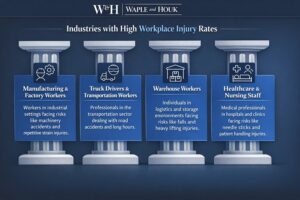
Slip and fall injuries are especially common in construction, warehousing, and healthcare settings. However, they can occur in any workplace. Even a fall in an office hallway qualifies if it happened during work hours while you were performing job duties.
Is Repetitive Stress Injury Covered by Workers’ Compensation?
Yes, though these claims are more difficult to prove. Repetitive motion injuries develop gradually rather than from a single accident. North Carolina law generally requires injuries to be caused by an identifiable accident. However, courts and the Industrial Commission have recognized that repetitive stress injuries can still qualify for coverage.

Common repetitive motion injuries covered under North Carolina workers’ comp include:
- Carpal tunnel syndrome from repeated keyboard use or assembly work
- Rotator cuff injuries from repetitive overhead lifting
- Tendinitis from sustained physical labor
- Bursitis in the shoulder, elbow, or knee
- Trigger finger from repetitive gripping tasks
Insurance carriers often dispute these claims by arguing the injury occurred outside of work. Documenting the connection between your job duties and the injury is essential. A workers’ compensation attorney can help gather medical evidence and build the strongest possible case.
Workers’ Comp Back Injury Coverage in North Carolina
Back injuries receive special treatment under North Carolina workers’ compensation law. Unlike most injuries, a workers’ comp back injury in North Carolina can be compensable even without an identifiable accident. If your back condition developed or worsened as a result of your regular work duties, you may still qualify for benefits.
This exception recognizes the physical demands placed on workers in construction, manufacturing, healthcare, and other labor-intensive fields. If you developed a back condition over time due to your job, do not assume you are ineligible. Learn more about reporting a work injury in North Carolina to protect your rights from the start.
Are Occupational Diseases Covered by Workers’ Compensation in NC?
Yes. North Carolina workers’ compensation covers occupational diseases that arise out of specific working conditions. North Carolina General Statute 97-53 provides a list of covered diseases. However, diseases not on the list may also qualify if you can show your employer placed you at significantly greater risk of developing the disease than the general public.

Common occupational diseases covered under North Carolina workers’ comp include:
- Asbestosis and other asbestos-related lung diseases
- Carbon monoxide poisoning
- Mercury, lead, brass, and zinc poisoning
- Anthrax from exposure in certain work environments
- Compressed-air illness in pressurized work settings
- Heart attack or stroke linked to work-related conditions in some circumstances
- Respiratory conditions from chemical exposure
Occupational disease claims require medical evidence linking the diagnosis to your specific working conditions. The timeline for filing these claims is also different. The statute of limitations typically runs from the date you knew or should have known your condition was work-related. For more on the process, see our guide on filing a workers’ compensation claim in North Carolina.
Does Workers’ Comp Cover Workplace Assault?
Yes, in certain circumstances. If you were assaulted while at work, you may be able to pursue a workers’ compensation claim for your injuries. The key requirement is that the assault must arise out of the employment relationship. The dispute or conflict must be connected to the workplace, not to a personal matter that carried over from outside of work.
Common injuries from workplace assault include cuts, bruises, broken bones, and head trauma. If the assault arose from a work-related disagreement or from the nature of your job, such as working in a setting that involves contact with the public, coverage is more likely to apply.
Insurance carriers frequently dispute assault claims. If you were injured in a workplace assault, consulting with a workers’ comp attorney before filing gives you the best chance of a successful outcome.
Can You Get Workers’ Comp for a Pre-Existing Condition?
Possibly. North Carolina workers’ compensation can cover a pre-existing condition if a workplace accident or work activities aggravated, accelerated, or combined with that condition to produce a disability. The fact that you had a prior injury or condition does not automatically disqualify your claim.
For example, if you had a prior back condition and a workplace accident made it significantly worse, the aggravation of that condition may be compensable. The insurer may argue that your symptoms are entirely due to the pre-existing condition and unrelated to work. Medical documentation of how the work accident changed your condition is critical in these cases.
What Injuries Are Not Covered by Workers’ Compensation in North Carolina?
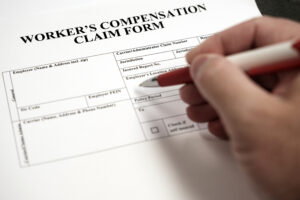
Not every injury that happens at or near work qualifies for coverage. Common exclusions include:
- Self-inflicted injuries. Injuries intentionally caused by the worker are not covered.
- Injuries during intoxication. If the injury occurred while you were under the influence of alcohol or drugs, coverage may be denied.
- Injuries during a deviation from employment. If you were doing something unrelated to your job when injured, the claim may be denied.
- Commuting to and from work. The “coming and going” rule generally excludes injuries that occur while traveling to or from your regular workplace. There are exceptions for workers who travel as part of their job duties, such as delivery drivers and others whose work requires regular travel.
- Injuries from horseplay. Injuries sustained during workplace horseplay may be excluded, particularly if the worker was the instigator.
- Purely psychological injuries without a physical component. Mental health conditions without a connected physical injury are more difficult to compensate under North Carolina law, though there are exceptions.
Even when an insurer denies a claim based on one of these exclusions, the denial is not always correct. Many claims that appear to fall into an exclusion can still be successfully argued. Learn more about challenging a disputed or denied workers’ compensation claim in North Carolina.
How Long Do You Have to Report a Work Injury in North Carolina?
You must report your work injury to your employer within 30 days of the accident. Failing to report within that window can jeopardize your entire claim, even if the injury is otherwise clearly compensable.
After reporting to your employer, you have two years from the date of the injury to file a formal claim with the North Carolina Industrial Commission. For occupational diseases, the two-year period typically begins from the date you knew or should have known your condition was work-related.
Do not wait to report an injury, even if it seems minor at first. Symptoms from workplace accidents can worsen over time. Early reporting protects your right to coverage for all related medical treatment and lost wages.
Was your workers’ comp claim denied in North Carolina?
If you are unsure whether your injury qualifies, or if your claim has already been disputed or denied, Waple & Houk, PLLC is here to help. Our attorneys have represented injured workers in Charlotte and throughout North Carolina for over 30 years. We offer a free case review and charge no fees unless we recover benefits for you.
Frequently Asked Questions About Workers’ Comp Coverage in North Carolina
Does workers’ comp cover injuries that happen off-site?
It depends on the circumstances. Injuries that occur away from your primary workplace can still be covered if you were performing job duties at the time. Workers who travel for their jobs, make deliveries, or work at multiple locations are generally covered while performing those duties. The key question is whether you were acting within the scope of your employment when the injury occurred.
What if my employer says my injury is not work-related?
Your employer’s opinion is not the final word. Workers’ compensation disputes in North Carolina are resolved through the North Carolina Industrial Commission. If your claim is denied or disputed, you have the right to request a hearing before a Deputy Commissioner. An attorney can gather medical records, witness statements, and other evidence to support your position.
Does workers’ comp cover mental health conditions in North Carolina?
North Carolina workers’ compensation generally covers mental health conditions when they are directly connected to a physical workplace injury. Purely psychological conditions without a physical component are more difficult to pursue under current state law. However, if a workplace accident caused both physical injuries and a resulting psychological condition such as post-traumatic stress, those mental health effects may be included in your claim.
What if I was partially at fault for my workplace accident?
North Carolina workers’ compensation operates on a no-fault basis. You do not need to prove your employer was negligent, and your own partial fault generally does not bar you from receiving benefits. The main exceptions are injuries caused by the worker’s own intentional conduct or intoxication.
Workers’ Compensation
And Family Lawyers
Providing
Strength In A
Time of Crisis
Call US now:
Our Success
Case Results
$80,000
Elbow Injury
$350,000
Arm Injury






Related Posts


reviews
What Real Clients Have To Say
Melissa S.

Lou and his team did an outstanding job on my case. They kept me updated constantly. There were times when I was so overwhelmed-the encouragement I received from the firm is the BEST I’ve received from any law firm in the past. I HIGHLY recommend Lou and his team.
Tim J.
Great attorney helped the most at a important time.
Aimee B.
Lou and his team worked quickly to ensure that my husband received the care and physical therapy he needed after a pretty serious work injury. They handled every phone call and question with the insurance adjuster, we didn’t have to fight with anyone to get anything that was expected or promised. They communicated with us every step of the way, and they were especially responsive and helpful when my husband’s case required more than anyone had anticipated. Every person we have spoken with in Lou’s office were patient and respectful, we never felt like we...
Lucas J.
Very good people to work with! I highly recommend this law firm.
Dustin M.
I have never had a more pleasant experience with an attorney and their paralegals in my life!!! Hands down the best law firm in North Carolina, probably the whole country! Would definitely recommend them to anyone needing counsel. They are all so easy to get along with and friendly.... My employer lied, as many do in this situation but Lou and his team were quick to step in and get me the compensation I deserved! Thank you, from my whole family. Waple and Houk are #1
Darrin R.
Mr. Lou is by far the most compassionate attorney I’ve encountered and once again he helped me with a worker’s compensation claim and his paralegal was also great. Mr.Lou is very professional and he allows you room for your concerns and opinions, he’s just a great human being that doesn’t need to advertise his partnership law firm on tv just ask any of his past clients and they would totally agree with me, God forbid that I’m in a serious car accident but if I am he’s just a phone call away so if you...
Travis B.
Mr. Waple did a fantastic job on my case, even if I wasn't a lot of help he still came through and for that I thank you Mr. Waple.
Tara D.
I was at a point of despair & thought that my then employer would do the right thing. Lou’s honesty, and integrity; along with his guidance gave me the dose of reality that I needed to see the true colors of legality in corporate America. Without his savvy I would have been blindsided! Cherie, always responded to all of my responses, and nervous reactions and made sure Lou was aware of what was happening! Great firm, I would highly recommend to anyone who wants respect, honesty and guidance as a client!
Aunyette S.
Mr.Waple has handled both of my cases very well. I definitely recommend this team of professional lawyers and secretaries. Thank you!
Tashaun H.
My experience working with Lou was an absolute joy. From our very first conversation, he assured me that he would work relentlessly to help me secure adequate compensation for my case and he did just that. His paralegal, Cheri, was helpful with timely responses to any and all questions I had and she helped reduce the stress of a very tedious process. I highly recommend this firm for any future litigation and would love to work with them again if the opportunity arises.