Serving All North Carolina
(704) 954-8697
North Carolina Workers’ Compensation Laws
Connect With Us
04Apr
By Waple & Houk PLLC | Charlotte Workers’ Compensation Attorneys | Updated 2026
North Carolina’s workers’ compensation system was established in 1929 under the North Carolina Workers’ Compensation Act (NCGS Chapter 97). Nearly 100 years later, it remains the primary legal framework protecting employees who are injured or become ill because of their jobs. If you work in North Carolina and you’ve been hurt at work, understanding how this system works, and what you’re entitled to, is the first step toward protecting yourself.
This guide covers the key workers’ compensation laws in North Carolina: who is required to carry coverage, what benefits injured workers can receive, the deadlines that matter, and how the system actually works in practice.
Is Workers’ Compensation Required in North Carolina?
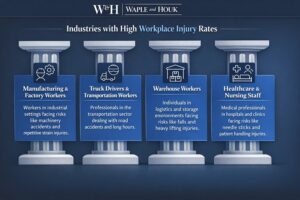
Yes — with very few exceptions. Under North Carolina law, any employer with three or more employees is required to carry workers’ compensation insurance. This applies across industries and job types, whether employees are full-time, part-time, or seasonal.
The requirement works differently depending on which side of the employment relationship you’re on:
- If you are an employee: You are never required to pay for workers’ compensation insurance. That obligation falls entirely on your employer. You cannot be charged premiums, deductibles, or any cost related to workers’ comp coverage.
- If you are an employer: If you have three or more employees, you must carry workers’ compensation insurance through a private carrier or qualify as a self-insured employer under the NC Workers’ Compensation Act. Failure to carry required coverage can result in serious penalties and personal liability.
Employers who cannot obtain coverage through private insurance may be eligible for coverage through the assigned risk pool administered by the North Carolina Rate Bureau. The entire system is regulated and overseen by the North Carolina Industrial Commission, located in Raleigh.
Who Is Eligible for Workers’ Compensation in North Carolina?

Most employees in North Carolina are covered by workers’ compensation. To be eligible for benefits, your situation generally must meet the following requirements:
- You are an employee (not an independent contractor) of a covered employer
- Your employer has three or more employees
- Your injury or illness arose out of and in the course and scope of your employment
- You were not under the influence of alcohol or drugs at the time of the incident
A few categories of workers are not covered under the standard NC workers’ comp system, including federal government employees (who have their own federal program), railroad workers (covered under the Federal Employers’ Liability Act), and certain domestic and agricultural workers. If you are unsure whether you are covered, speaking with a workers’ compensation attorney is the fastest way to get a clear answer.
One important note on independent contractors: being labeled a contractor by your employer does not automatically mean you are one legally. Courts look at the actual nature of the working relationship — who controls your schedule, who provides equipment, whether you work for other clients. If you are functionally an employee, you may qualify for workers’ comp benefits even if you were classified as a contractor.
How Does Workers’ Compensation Work in North Carolina?

Workers’ compensation in North Carolina operates as a no-fault system. You do not need to prove that your employer did anything wrong, only that your injury or illness occurred in the course and scope of your employment. In exchange for this relatively lower burden of proof, the system limits the types of compensation available. You cannot sue your employer for pain and suffering through workers’ comp; the benefits are defined and specific.
When a workplace injury occurs, the system works roughly as follows: you report the injury to your employer, your employer notifies their insurance carrier, the insurance company investigates and either approves or denies the claim, and approved claims begin paying medical benefits and, if applicable, wage replacement. If a claim is denied, the worker has the right to appeal to the North Carolina Industrial Commission.
The insurance company — not your employer — ultimately controls whether your claim is approved. Even if your employer believes your injury is legitimate and wants your claim paid, the insurer has the final word. This is why having an attorney involved early can make a significant difference in how your claim is handled.
What Benefits Are Available Under NC Workers’ Compensation Laws?

Medical Benefits
Workers’ compensation covers all medical treatment reasonably required to treat a work-related injury or illness. This includes emergency room visits, surgery, prescription medications, physical therapy, medical equipment, and follow-up care. In North Carolina, your employer’s insurance company initially selects your treating physician. However, you have the right to seek a second opinion and, in many cases, to request a change of physician if your current treatment isn’t helping you improve.
Temporary Total Disability (TTD) Benefits
If your injury prevents you from working at all during your recovery, you are entitled to temporary total disability benefits equal to two-thirds of your average gross weekly wage. These benefits are not taxed, which often means the take-home amount is closer to your normal pay than it may initially appear. TTD benefits continue until you are cleared to return to work or are determined to have reached maximum medical improvement (MMI).
Temporary Partial Disability (TPD) Benefits
If you can return to work in a limited capacity but earn less than you did before your injury, you may qualify for temporary partial disability benefits — two-thirds of the difference between your pre-injury and post-injury wages.
Permanent Disability Benefits
North Carolina law provides scheduled benefits for permanent impairment to specific body parts. For example, the total loss of a thumb entitles a worker to 75 weeks of compensation; an index finger, 40 weeks; total loss of vision in one eye, 120 weeks. For injuries not on the schedule, permanent partial disability is based on an impairment rating assigned by a physician. Permanent total disability — when an injury prevents a worker from ever returning to any employment — can provide ongoing weekly payments for life.
Vocational Rehabilitation
If your injury prevents you from returning to your previous job, vocational rehabilitation benefits can cover job retraining, education, and placement assistance to help you transition to a new career.
Death Benefits
If a workplace accident results in death, the worker’s dependents are entitled to death benefits and funeral expenses up to $10,000.
What Workers’ Comp Does Not Cover
North Carolina workers’ compensation does not provide compensation for pain and suffering. It also does not cover injuries sustained while traveling to or from work (with limited exceptions for workers whose employment involves travel as a core function). If you believe you have a claim that falls outside the workers’ comp system — for example, against a third party who caused your injury — an attorney can help you evaluate your options.
Key Deadlines Under North Carolina Workers’ Compensation Law

- 30 days: You must report your injury to your employer within 30 days of when it occurred. For occupational diseases or gradually developing conditions, the 30 days begins when you knew or should have known the condition was work-related.
- 2 years: You have two years from the date of injury to file a formal claim with the North Carolina Industrial Commission by submitting Form 18.
Missing either of these deadlines can seriously damage or completely bar your claim. The two-year window exists in part to protect workers who may not immediately realize the extent of their injuries — particularly those with occupational diseases that develop over time. As soon as you become aware of an injury or illness and its connection to your job, act promptly.
Mental Health and Occupational Disease Coverage
North Carolina workers’ compensation covers more than physical injuries. Psychological conditions — including PTSD, severe anxiety, and other mental health conditions — can qualify as compensable injuries when they are directly connected to a specific workplace event or series of events. General job stress alone is generally not sufficient; the condition must be tied to a specific, identifiable workplace incident.
Occupational diseases are also covered. If your work causes or significantly contributes to a disease — such as hearing loss from prolonged machinery exposure, lung disease from chemical inhalation, or repetitive stress conditions like carpal tunnel syndrome — you may have a compensable workers’ comp claim even without a single accident event.
Have Questions About NC Workers’ Compensation Laws?
Understanding your rights under North Carolina’s workers’ compensation system is the first step. Knowing how to protect those rights in practice is where an experienced attorney makes a real difference. Insurance companies have legal teams working to minimize what they pay. You deserve the same level of representation.
At Waple & Houk PLLC, our Charlotte workers’ compensation attorneys handle cases throughout North Carolina on a contingency fee basis. You pay nothing unless we win. Contact us today for a free consultation.
Workers’ Compensation
And Family Lawyers
Providing
Strength In A
Time of Crisis
Call US now:
Our Success
Case Results
$80,000
Elbow Injury
$350,000
Arm Injury






Related Posts


reviews
What Real Clients Have To Say
Melissa S.

Lou and his team did an outstanding job on my case. They kept me updated constantly. There were times when I was so overwhelmed-the encouragement I received from the firm is the BEST I’ve received from any law firm in the past. I HIGHLY recommend Lou and his team.
Tim J.
Great attorney helped the most at a important time.
Aimee B.
Lou and his team worked quickly to ensure that my husband received the care and physical therapy he needed after a pretty serious work injury. They handled every phone call and question with the insurance adjuster, we didn’t have to fight with anyone to get anything that was expected or promised. They communicated with us every step of the way, and they were especially responsive and helpful when my husband’s case required more than anyone had anticipated. Every person we have spoken with in Lou’s office were patient and respectful, we never felt like we...
Lucas J.
Very good people to work with! I highly recommend this law firm.
Dustin M.
I have never had a more pleasant experience with an attorney and their paralegals in my life!!! Hands down the best law firm in North Carolina, probably the whole country! Would definitely recommend them to anyone needing counsel. They are all so easy to get along with and friendly.... My employer lied, as many do in this situation but Lou and his team were quick to step in and get me the compensation I deserved! Thank you, from my whole family. Waple and Houk are #1
Darrin R.
Mr. Lou is by far the most compassionate attorney I’ve encountered and once again he helped me with a worker’s compensation claim and his paralegal was also great. Mr.Lou is very professional and he allows you room for your concerns and opinions, he’s just a great human being that doesn’t need to advertise his partnership law firm on tv just ask any of his past clients and they would totally agree with me, God forbid that I’m in a serious car accident but if I am he’s just a phone call away so if you...
Travis B.
Mr. Waple did a fantastic job on my case, even if I wasn't a lot of help he still came through and for that I thank you Mr. Waple.
Tara D.
I was at a point of despair & thought that my then employer would do the right thing. Lou’s honesty, and integrity; along with his guidance gave me the dose of reality that I needed to see the true colors of legality in corporate America. Without his savvy I would have been blindsided! Cherie, always responded to all of my responses, and nervous reactions and made sure Lou was aware of what was happening! Great firm, I would highly recommend to anyone who wants respect, honesty and guidance as a client!
Aunyette S.
Mr.Waple has handled both of my cases very well. I definitely recommend this team of professional lawyers and secretaries. Thank you!
Tashaun H.
My experience working with Lou was an absolute joy. From our very first conversation, he assured me that he would work relentlessly to help me secure adequate compensation for my case and he did just that. His paralegal, Cheri, was helpful with timely responses to any and all questions I had and she helped reduce the stress of a very tedious process. I highly recommend this firm for any future litigation and would love to work with them again if the opportunity arises.