Serving All North Carolina
(704) 954-8697
How to File a Workers’ Compensation Claim
Connect With Us
28Apr
A workplace injury can turn your life upside down in an instant. Medical bills start piling up, and you may be missing work. On top of all that, you are trying to figure out what to do next. The good news is that North Carolina gives every injured worker a clear path to benefits, but the steps matter, and so does timing. Acting quickly can be the difference between getting the help you need and losing your right to those benefits altogether.
This guide walks you through how to file a workers’ compensation claim in North Carolina, from immediately after an injury to what happens once your claim is submitted.
What Is Workers’ Compensation in North Carolina?
Workers’ compensation is a state-mandated insurance program. It covers employees who are hurt on the job or diagnosed with a work-related illness. In North Carolina, most employers with three or more employees are required by law to carry this coverage. If you are injured while doing your job, you are generally entitled to benefits regardless of who was at fault.
Those compensation benefits can include payment for medical treatment, prescriptions, and hospital stays. They can also include wage replacement if your doctor takes you out of work. In serious cases, a worker may be entitled to disability payments or a settlement.
Step 1: Report Your Injury to Your Employer Right Away
This is the most time-sensitive step. In North Carolina, you must report your workplace injury to your employer within 30 days of the incident. Missing this deadline can put your entire claim at risk.
Do not rely on a verbal conversation alone. Put it in writing by sending an email or a written note to your supervisor or HR department. Include the date, time, and a brief description of what happened. For example, if you slipped on a wet floor and hurt your back on a Tuesday morning, write that down and send it that same day.
Your employer is then required to complete Form 19 and provide you with a blank Form 18. Those forms are the foundation of your workers’ compensation claim process.
Step 2: Get Medical Care Immediately
Do not wait to see a doctor. Seeking prompt medical care protects your health and creates an official record of your injury. That record becomes important evidence in your compensation claim.
In North Carolina, your employer or their insurance carrier generally has the right to direct your medical care. This means they may designate which doctor you should see. Follow that process unless it is an emergency. If you need emergency treatment, go to the nearest emergency room first.
Once you are under care, follow your doctor’s treatment plan closely. Injured employee medical care records are closely reviewed during the claims process. Missing appointments or ignoring medical advice can be used against you later. Insurers watch for gaps in treatment and will use them to argue your injury is not as serious as you say.
Step 3: File Form 18 with the NC Industrial Commission
Form 18 is the official form you file directly with the North Carolina Industrial Commission (NCIC). This is what formally starts your workers’ comp claim with the state.
You need to fill out this form carefully. It asks for details about how the injury happened, the date and time, and which parts of your body were affected. Incomplete or inaccurate information can delay your claim or give the insurance company grounds to dispute it.
You must submit Form 18 within two years of the date of your injury. However, do not wait. The sooner you file, the sooner benefits can begin. Delays in claim filing are frequently used as a defense by employers and insurers.
Step 4: Watch for Your Employer’s Response
After you file, your employer has 30 days to respond. They will do so through one of three forms. Form 60 means they are accepting your claim. Form 61 means they are denying it. Form 63 means they need more time to investigate.
If you receive a Form 60, your benefits should begin. If you receive a Form 61 or 63, do not panic, but do not wait either. You have the right to request a hearing with the NC Industrial Commission by filing Form 33. An attorney can help you navigate that process and build your case.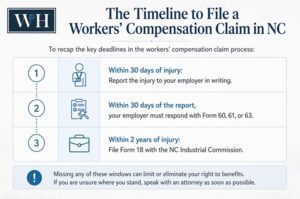
Step 5: Follow Up and Stay Engaged
Filing the claim is not the finish line. What happens after you file a workers’ comp claim depends largely on how well you stay on top of the claims process. Keep copies of everything. Respond promptly to the insurance adjuster’s requests. Attend all medical appointments. Let your employer know if your doctor clears you for light duty.
The insurance company will assign an adjuster to your case. Their job is to manage costs for the insurer. They are not on your side. Be cooperative, but be careful about what you say. Stick to the facts about your injury and treatment. This is true whether your situation involves workplace accidents, occupational illnesses, or gradual injuries that develop over time.
Common Mistakes That Can Hurt Your Claim
Many workers make errors early on that come back to haunt them. Here are the most common ones to avoid.
Waiting too long to report. The 30-day reporting deadline in North Carolina is strict. Even a short delay gives the insurance company a reason to question your claim.
Not following your doctor’s orders. If your doctor says to rest and you post photos of yourself doing yard work, the insurer will find out. Follow your treatment plan exactly as prescribed.
Leaving out details on Form 18. Vague descriptions of your injury or how it happened can create problems. Be specific and accurate.
Assuming your employer will handle everything. Some employers are supportive, but others are not. Do not assume the process is moving forward. Follow up and verify.
Not talking to an attorney early enough. Many injured workers wait until a claim is denied before calling a lawyer. By then, valuable time and evidence may be lost.
Do You Need a Lawyer to File a Workers’ Comp Claim?
You are not legally required to have an attorney to file. Simple claim situations involving minor injuries and a cooperative employer can sometimes proceed without legal help, but workers’ compensation cases are rarely as simple as they first appear.
Insurance companies are experienced at minimizing payouts. If your injury is serious, your workers’ comp case is disputed, or your employer is pushing back, having an attorney on your side makes a significant difference. A workers’ compensation attorney in Charlotte can make sure your paperwork is correct, your deadlines are met, and your rights are protected every step of the way.
At Waple & Houk, we have spent decades helping injured workers in North Carolina get the workers’ compensation benefits they are owed. Contact us today for a free consultation.
Workers’ Compensation
And Family Lawyers
Providing
Strength In A
Time of Crisis
Call US now:
Our Success
Case Results
$80,000
Elbow Injury
$350,000
Arm Injury






Related Posts


reviews
What Real Clients Have To Say
Melissa S.

Lou and his team did an outstanding job on my case. They kept me updated constantly. There were times when I was so overwhelmed-the encouragement I received from the firm is the BEST I’ve received from any law firm in the past. I HIGHLY recommend Lou and his team.
Tim J.
Great attorney helped the most at a important time.
Aimee B.
Lou and his team worked quickly to ensure that my husband received the care and physical therapy he needed after a pretty serious work injury. They handled every phone call and question with the insurance adjuster, we didn’t have to fight with anyone to get anything that was expected or promised. They communicated with us every step of the way, and they were especially responsive and helpful when my husband’s case required more than anyone had anticipated. Every person we have spoken with in Lou’s office were patient and respectful, we never felt like we...
Lucas J.
Very good people to work with! I highly recommend this law firm.
Dustin M.
I have never had a more pleasant experience with an attorney and their paralegals in my life!!! Hands down the best law firm in North Carolina, probably the whole country! Would definitely recommend them to anyone needing counsel. They are all so easy to get along with and friendly.... My employer lied, as many do in this situation but Lou and his team were quick to step in and get me the compensation I deserved! Thank you, from my whole family. Waple and Houk are #1
Darrin R.
Mr. Lou is by far the most compassionate attorney I’ve encountered and once again he helped me with a worker’s compensation claim and his paralegal was also great. Mr.Lou is very professional and he allows you room for your concerns and opinions, he’s just a great human being that doesn’t need to advertise his partnership law firm on tv just ask any of his past clients and they would totally agree with me, God forbid that I’m in a serious car accident but if I am he’s just a phone call away so if you...
Travis B.
Mr. Waple did a fantastic job on my case, even if I wasn't a lot of help he still came through and for that I thank you Mr. Waple.
Tara D.
I was at a point of despair & thought that my then employer would do the right thing. Lou’s honesty, and integrity; along with his guidance gave me the dose of reality that I needed to see the true colors of legality in corporate America. Without his savvy I would have been blindsided! Cherie, always responded to all of my responses, and nervous reactions and made sure Lou was aware of what was happening! Great firm, I would highly recommend to anyone who wants respect, honesty and guidance as a client!
Aunyette S.
Mr.Waple has handled both of my cases very well. I definitely recommend this team of professional lawyers and secretaries. Thank you!
Tashaun H.
My experience working with Lou was an absolute joy. From our very first conversation, he assured me that he would work relentlessly to help me secure adequate compensation for my case and he did just that. His paralegal, Cheri, was helpful with timely responses to any and all questions I had and she helped reduce the stress of a very tedious process. I highly recommend this firm for any future litigation and would love to work with them again if the opportunity arises.