Serving All North Carolina
(704) 954-8697
Injured in a Charlotte Company Vehicle Accident? Here Is What You Need to Know
Connect With Us
28Apr
Getting hurt in a work vehicle crash raises questions that a typical car accident does not. Workers’ comp may cover job-related car crashes, but who is liable? Is your employer responsible? What if another driver caused the wreck? Many injured employees are not sure which direction to turn. That confusion can cost them time and benefits they are entitled to.
Learn exactly how workers’ compensation and work-related vehicle accidents interact in North Carolina, who may be liable, and what you should do right after the crash to protect yourself.
Does Workers’ Compensation Cover a Work Car Accident?
The short answer is usually yes. Workers’ comp covers car accidents at work when the car accident happens while you are performing job duties. If you were driving a company vehicle to make a delivery, travel between job sites, or run an errand for your employer, you are generally covered under North Carolina workers’ compensation.
Workers’ compensation pays for your medical treatment and a portion of your lost wages. It does not matter who caused the crash. Even if you made a mistake behind the wheel, you’re still covered as long as you were acting within the scope of your employment at the time.
There are exceptions. If you were using the work vehicle for a personal errand or had significantly detoured from your job duties, coverage may be disputed. For example, if you took a work truck to run a personal errand after your shift and were hit on the way, your employer’s compensation insurance carrier may argue the crash falls outside the scope of employment.
Who Is Liable After a Company Car Accident?
Liability in a work car accident depends on the circumstances. There are typically two scenarios to consider.
Scenario 1: You are the employee driving a company car. Your employer is generally responsible for accidents that happen while you are doing your job. This is based on a legal principle called respondeat superior, which holds employers liable for their workers’ actions on the job. So if you are involved in a company car accident while on a work-related trip, employer liability typically applies. You may be entitled to workers’ compensation benefits regardless of fault.
Scenario 2: A third party caused the crash. If another driver ran a red light and hit you while you were in a work vehicle, that driver may be personally liable for your injuries. This opens the door to a third-party personal injury claim in addition to your workers’ compensation benefits. In North Carolina, you may obtain workers’ compensation benefits and pursue a third-party claim at the same time. Workers’ compensation covers your immediate medical costs and wage replacement. A third-party claim can pursue additional damages such as pain and suffering, which your workers’ compensation carrier does not cover.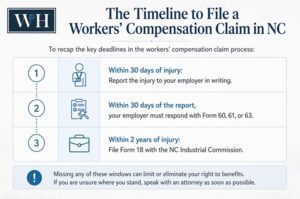
What If You Were a Passenger in a Work Vehicle?
If you were a passenger in a work vehicle and were injured in a crash, you are still entitled to workers’ compensation benefits. The same rule applies: you must have been traveling for work purposes at the time. For instance, if a coworker was driving and lost control on the way to a job site, an injured worker in that vehicle can file a work vehicle accident claim for their injuries.
In this situation, you may also have a third-party claim against the at-fault driver, whether that is your coworker personally or another motorist. A lawyer can help you identify every potential avenue for recovery.
What Happens If You Crash a Company Car in Charlotte?
This is one of the most common questions employees ask. If you crash a company vehicle while on the job, here is what generally happens. Your employer’s commercial auto insurance covers damage to the vehicle and any property damage to others. Workers’ compensation covers your personal injuries. Payment for vehicle repairs is typically not your responsibility when the crash occurred during work duties.
Your employer may investigate the crash and review the incident with their insurance provider. They may also discipline you for policy violations, but they cannot legally retaliate against you for filing a workers’ compensation claim. North Carolina law protects employees from retaliation.
Steps to Take After a Work Vehicle Accident in Charlotte
The steps you take in the hours and days after the crash matter more than most people realize. Here is what to do.
Call 911 and stay at the scene. Get a police report filed. This creates an official record of what happened and who was involved.
Seek medical care right away. Even if you feel okay, see a doctor the same day. Some injuries, like whiplash or internal trauma, do not show symptoms immediately. Your medical records from this visit are critical evidence in your workers’ compensation claim.
Report the injury to your employer. In North Carolina, you must notify your employer within 30 days of a workplace injury. Do it in writing. Keep a copy for yourself.
Document everything. Take photos of the scene, the vehicles, your injuries, and any road conditions that may have contributed. Get contact information from any witnesses.
Do not give a recorded statement to the insurance company without speaking to an attorney first. Adjusters are trained to ask questions in ways that can minimize your compensation claim.
Mistakes That Can Cost You Compensation Benefits
Waiting too long to report. Missing the 30-day reporting window in North Carolina can jeopardize your right to benefits entirely.
Assuming workers’ compensation is your only option. If a third party caused the crash, you may have additional claims available. Many injured employees leave money on the table by not exploring all of their options.
Not following your doctor’s treatment plan. Gaps in treatment give insurers reason to argue your injuries are not as serious as you claim. Follow through on every appointment and referral.
Talking too freely about the crash. What you say to your employer, the insurance adjuster, or even on social media can be used against you. Stick to the facts and let your attorney handle communications when possible.
Protecting Your Workers’ Compensation Benefits After a Company Vehicle Accident
Work vehicle accidents are rarely straightforward. Between workers’ compensation coverage, potential third-party liability, employer insurance, and the North Carolina Industrial Commission, there are multiple moving parts, and missing any one of them can mean leaving compensation on the table.
If you were injured in a company vehicle and are not sure what your options are, speaking with a workers’ compensation attorney early can help you get a clearer picture when filing your claim, and before any decisions are made that are difficult to undo.
The team at Waple & Houk, PLLC, is available to answer questions. Call or schedule a consultation online at your convenience.
Workers’ Compensation
And Family Lawyers
Providing
Strength In A
Time of Crisis
Call US now:
Our Success
Case Results
$80,000
Elbow Injury
$350,000
Arm Injury
Related Posts


reviews
What Real Clients Have To Say
Melissa S.

Lou and his team did an outstanding job on my case. They kept me updated constantly. There were times when I was so overwhelmed-the encouragement I received from the firm is the BEST I’ve received from any law firm in the past. I HIGHLY recommend Lou and his team.
Tim J.
Great attorney helped the most at a important time.
Aimee B.
Lou and his team worked quickly to ensure that my husband received the care and physical therapy he needed after a pretty serious work injury. They handled every phone call and question with the insurance adjuster, we didn’t have to fight with anyone to get anything that was expected or promised. They communicated with us every step of the way, and they were especially responsive and helpful when my husband’s case required more than anyone had anticipated. Every person we have spoken with in Lou’s office were patient and respectful, we never felt like we...
Lucas J.
Very good people to work with! I highly recommend this law firm.
Dustin M.
I have never had a more pleasant experience with an attorney and their paralegals in my life!!! Hands down the best law firm in North Carolina, probably the whole country! Would definitely recommend them to anyone needing counsel. They are all so easy to get along with and friendly.... My employer lied, as many do in this situation but Lou and his team were quick to step in and get me the compensation I deserved! Thank you, from my whole family. Waple and Houk are #1
Darrin R.
Mr. Lou is by far the most compassionate attorney I’ve encountered and once again he helped me with a worker’s compensation claim and his paralegal was also great. Mr.Lou is very professional and he allows you room for your concerns and opinions, he’s just a great human being that doesn’t need to advertise his partnership law firm on tv just ask any of his past clients and they would totally agree with me, God forbid that I’m in a serious car accident but if I am he’s just a phone call away so if you...
Travis B.
Mr. Waple did a fantastic job on my case, even if I wasn't a lot of help he still came through and for that I thank you Mr. Waple.
Tara D.
I was at a point of despair & thought that my then employer would do the right thing. Lou’s honesty, and integrity; along with his guidance gave me the dose of reality that I needed to see the true colors of legality in corporate America. Without his savvy I would have been blindsided! Cherie, always responded to all of my responses, and nervous reactions and made sure Lou was aware of what was happening! Great firm, I would highly recommend to anyone who wants respect, honesty and guidance as a client!
Aunyette S.
Mr.Waple has handled both of my cases very well. I definitely recommend this team of professional lawyers and secretaries. Thank you!
Tashaun H.
My experience working with Lou was an absolute joy. From our very first conversation, he assured me that he would work relentlessly to help me secure adequate compensation for my case and he did just that. His paralegal, Cheri, was helpful with timely responses to any and all questions I had and she helped reduce the stress of a very tedious process. I highly recommend this firm for any future litigation and would love to work with them again if the opportunity arises.

Request a Consultation
We Are Here For You

NUVEW | Copyright 2026 All Rights Reserved | Accessibility Notice | Privacy Policy
Attorney Advertising. This information is designed for general information only. The information presented should not be construed to be formal legal advice nor the formation of a lawyer/client relationship. Past results and testimonials are not a guarantee, warranty, or prediction of the outcome of your case, and should not be construed as such. Past results cannot guarantee future performance. Any result in a single case is not meant to create an expectation of similar results in future matters because each case involves many different factors, therefore, results will differ on a case-by-case basis. By providing contact information, users acknowledge and give explicit consent to be contacted via the methods of communication provided, including SMS. Message and data rates may apply. Message frequency may vary. Reply STOP to opt out.