Serving All North Carolina
(704) 954-8697
How Workers’ Compensation Applies to Workplace Chemical Exposure
Connect With Us
19Aug
Two workers exposed to the same industrial solvent can end up filing completely different types of claims. One might suffer a single bad afternoon, a spill, a ventilation failure, an obvious acute reaction, and file an injury claim within days. The other might work around the same chemical for years, only developing a diagnosed lung or nerve condition well after they have moved to a different job. North Carolina treats these two situations under entirely different rules, with different deadlines and different proof requirements.

Understanding which category a chemical exposure workers’ compensation claim actually falls into matters. Determining which type of claim applies can affect the deadlines, evidence, and medical proof involved. A Charlotte workers’ compensation lawyer can help determine how North Carolina’s rules apply when a workplace exposure leads to an injury or illness.
Chemical Exposure Workers Compensation: Two Different Claim Types
North Carolina workers’ compensation law separates claims into two broad categories: injury by accident and occupational disease. A workplace chemical exposure may be handled as an injury by accident when it results from a specific workplace event, while illnesses that develop from occupational exposure over time may fall under North Carolina’s occupational disease rules.
Acute Chemical Exposure at Work: Injury by Accident Rules
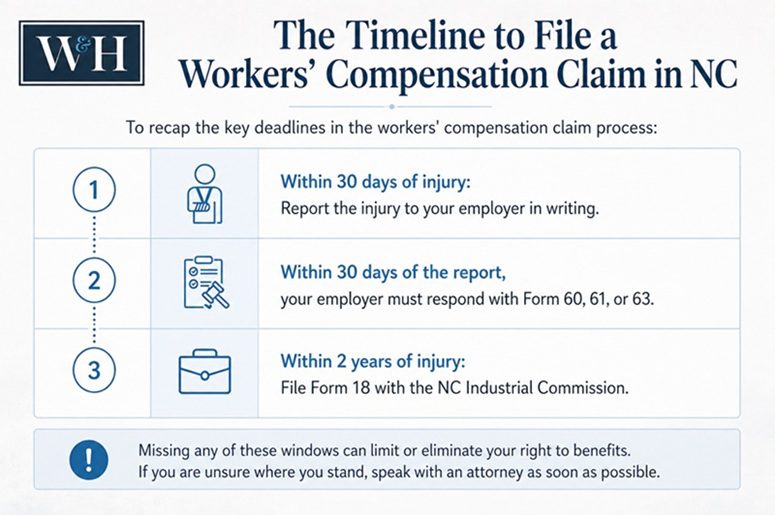
A single incident, an unexpected chemical release, a mixing error, a ventilation system failure generally gets treated as an injury by accident. These claims follow the standard timeline: written notice to the employer within 30 days of the incident, and a claim filed with the Industrial Commission within two years of the accident date. The clock starts on a specific, identifiable day, which makes these claims more straightforward to document, provided the worker seeks care and reports the incident promptly.
Occupational Illness From Chemical Exposure
Gradual chemical exposure can follow a different timeline than a single workplace accident. Under North Carolina Statute § 97-58, the two-year filing period for an occupational disease does not necessarily begin when the exposure ends or when the worker leaves the job. Generally, the filing period begins once the disease has caused disability or disablement and the worker has been informed by competent medical authority that the condition is work-related. The timing of occupational disease claims has also been addressed in cases such as Dowdy v. Fieldcrest Mills.
In practice, this means a worker who was exposed to a chemical years ago and is only later diagnosed with a condition connected to that exposure may still have a timely claim. The amount of time that has passed since the worker left the job does not, by itself, determine whether the filing deadline has expired.

The “Last Injurious Exposure” Rule for Workers Who Changed Jobs
Workers who were exposed to the same occupational hazard while working for more than one employer can face another question: which employer is responsible for the claim? Under North Carolina Statute § 97-57, liability generally falls on the employer where the worker was last injuriously exposed to the hazards of the occupational disease, rather than necessarily the employer where the exposure lasted the longest or was most severe.
Identifying that employer can be particularly important for workers who spent years performing similar jobs for different companies. Employment history, the substances involved, and the timing and nature of each exposure may all become relevant when determining which employer and insurance carrier are responsible.
Proving a Workplace Toxic Exposure Claim: The Documentation Challenge
An acute chemical incident often leaves a relatively clear paper trail: an emergency room visit, an incident report, and a specific date of exposure. A claim involving gradual exposure may be harder to document. Symptoms can develop slowly or overlap with other health conditions, making a detailed history of what the worker was exposed to, how often, and for how long particularly important.
Safety Data Sheets can help identify hazardous chemicals used in the workplace and provide information about their ingredients, recognized health hazards, and safe handling and exposure precautions. These records can give medical providers more specific information when evaluating whether a diagnosed condition may be related to workplace exposure. Employment records, job duties, medical records, and information about the duration and frequency of exposure may also become important when establishing the connection between the worker’s condition and the job.

Charlotte Workers Who May Face Chemical Exposure
Chemical exposure can occur across a wide range of Charlotte workplaces. Manufacturing employees may work around solvents, degreasers, coatings, and other industrial chemicals, while healthcare workers can encounter sterilizing agents, disinfectants, cleaning products, and other substances used in clinical settings.
Workers in automotive repair, industrial cleaning, commercial painting, maintenance, and construction may also encounter hazardous substances as part of their jobs. For an occupational disease claim, the important issue is not simply whether chemicals were present at the workplace, but whether the worker’s actual exposure can be medically connected to the diagnosed condition.

Workers’ Comp Occupational Illness: What Statute 97-53 Covers
Workers’ compensation claims involving occupational illness may fall under North Carolina Statute § 97-53, which specifically identifies a number of recognized occupational diseases, including certain forms of chemical poisoning. Even when a condition is specifically listed, the worker still needs evidence connecting the disease to the workplace exposure.
Conditions that are not specifically named in the statute may still qualify under its broader occupational disease provision. These claims generally require evidence showing that the disease is characteristic of and peculiar to the worker’s employment rather than an ordinary disease to which the public is equally exposed. Medical evidence connecting the condition to the worker’s particular exposure is also important.
Understanding Chemical Exposure and Your Workers’ Compensation Claim
Chemical exposure claims do not all follow the same path. A sudden exposure caused by a spill, equipment failure, or other identifiable event may be handled differently from an illness that develops after months or years of exposure. That distinction can affect filing deadlines, the evidence needed to support the claim, and, in occupational disease cases, which employer and insurance carrier may be responsible.
A diagnosis that comes years after a worker leaves a job is not automatically too late to pursue, just as a recent chemical exposure does not automatically establish a compensable claim. The circumstances of the exposure, medical diagnosis, employment history, and applicable North Carolina workers’ compensation rules all need to be considered together.
If you developed an injury or illness after chemical exposure at work, Waple & Houk can review your medical and employment history, determine which workers’ compensation rules may apply, and help you understand the next steps in your claim.
Questions About a Workplace Chemical Exposure?
Waple & Houk can review how the exposure occurred and help determine which North Carolina workers' compensation rules may apply to your claim.
Contact Waple & HoukWorkers’ Compensation
And Family Lawyers
Providing
Strength In A
Time of Crisis
Call US now:
Our Success
Case Results
$80,000
Elbow Injury
$350,000
Arm Injury






Related Posts


reviews
What Real Clients Have To Say
Melissa S.

Lou and his team did an outstanding job on my case. They kept me updated constantly. There were times when I was so overwhelmed-the encouragement I received from the firm is the BEST I’ve received from any law firm in the past. I HIGHLY recommend Lou and his team.
Tim J.
Great attorney helped the most at a important time.
Aimee B.
Lou and his team worked quickly to ensure that my husband received the care and physical therapy he needed after a pretty serious work injury. They handled every phone call and question with the insurance adjuster, we didn’t have to fight with anyone to get anything that was expected or promised. They communicated with us every step of the way, and they were especially responsive and helpful when my husband’s case required more than anyone had anticipated. Every person we have spoken with in Lou’s office were patient and respectful, we never felt like we...
Lucas J.
Very good people to work with! I highly recommend this law firm.
Dustin M.
I have never had a more pleasant experience with an attorney and their paralegals in my life!!! Hands down the best law firm in North Carolina, probably the whole country! Would definitely recommend them to anyone needing counsel. They are all so easy to get along with and friendly.... My employer lied, as many do in this situation but Lou and his team were quick to step in and get me the compensation I deserved! Thank you, from my whole family. Waple and Houk are #1
Darrin R.
Mr. Lou is by far the most compassionate attorney I’ve encountered and once again he helped me with a worker’s compensation claim and his paralegal was also great. Mr.Lou is very professional and he allows you room for your concerns and opinions, he’s just a great human being that doesn’t need to advertise his partnership law firm on tv just ask any of his past clients and they would totally agree with me, God forbid that I’m in a serious car accident but if I am he’s just a phone call away so if you...
Travis B.
Mr. Waple did a fantastic job on my case, even if I wasn't a lot of help he still came through and for that I thank you Mr. Waple.
Tara D.
I was at a point of despair & thought that my then employer would do the right thing. Lou’s honesty, and integrity; along with his guidance gave me the dose of reality that I needed to see the true colors of legality in corporate America. Without his savvy I would have been blindsided! Cherie, always responded to all of my responses, and nervous reactions and made sure Lou was aware of what was happening! Great firm, I would highly recommend to anyone who wants respect, honesty and guidance as a client!
Aunyette S.
Mr.Waple has handled both of my cases very well. I definitely recommend this team of professional lawyers and secretaries. Thank you!
Tashaun H.
My experience working with Lou was an absolute joy. From our very first conversation, he assured me that he would work relentlessly to help me secure adequate compensation for my case and he did just that. His paralegal, Cheri, was helpful with timely responses to any and all questions I had and she helped reduce the stress of a very tedious process. I highly recommend this firm for any future litigation and would love to work with them again if the opportunity arises.