Serving All North Carolina
(704) 954-8697
North Carolina First Responders: Know Your Workers’ Compensation Rights
Connect With Us
27Jun
First responders in North Carolina are injured on the job at rates that far exceed most other professions, and the injuries they sustain are often more severe. Firefighters face burns, smoke inhalation, and cardiac events. Police officers encounter physical assaults and vehicle accidents. Paramedics and EMTs sustain musculoskeletal injuries from patient handling and are exposed to infectious diseases. All of them may develop psychological injuries that are harder to see but no less real. North Carolina’s workers’ compensation system covers these workers, but navigating it successfully requires understanding rights that are not always clearly communicated by employers or their insurers.
Workers’ Compensation Coverage for First Responders
First responders’ workers’ compensation rights begin with the same foundation as coverage for any other employee: if you are injured in the course and scope of your employment, you are entitled to workers’ compensation benefits. For first responders, the course and scope analysis often extends beyond what happens at the station or the office. A firefighter injured while responding to a call, a police officer hurt during a pursuit, and a paramedic who sustains a back injury lifting a patient are all in the course and scope of their employment even though the injury did not occur in a conventional workplace setting.

North Carolina requires most employers to carry workers’ compensation coverage for their employees. Local governments, counties, and municipalities that employ first responders are covered employers under North Carolina law. Volunteer firefighters present a different situation and have access to separate state benefits through the NC State Firemen’s Association rather than the standard workers’ compensation system.
According to the U.S. Bureau of Labor Statistics, protective service occupations, which include police, firefighters, and emergency medical personnel, consistently rank among the highest injury rate occupations in the country. In North Carolina, where Charlotte’s rapid growth has increased emergency response demands across Mecklenburg County, first responder injury volume continues to be a significant occupational safety concern.
Common Injuries That Trigger First Responder Claims
The injuries that send first responders into the workers’ compensation system reflect the hazards of their work. Some are acute and obvious. Others develop over time and require careful documentation to establish the work connection.
Physical Injuries Across First Responder Roles
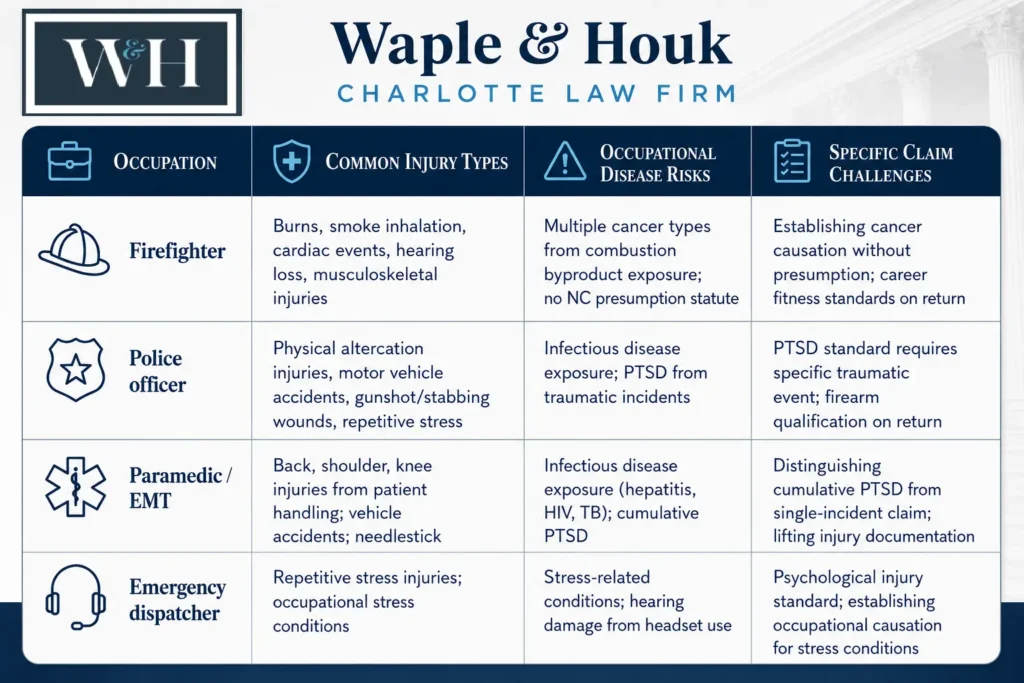
- Firefighters: burns, smoke inhalation injuries, structural collapse injuries, cardiac events during active firefighting, and hearing loss from sustained noise exposure
- Police officers: injuries from physical altercations, motor vehicle accidents during patrol or pursuit, gunshot or stabbing wounds, and repetitive stress injuries from equipment use
- Paramedics and EMTs: back, shoulder, and knee injuries from patient lifting and transfers, vehicle accidents during emergency response, and needlestick or infectious disease exposures
- Emergency dispatchers: often overlooked, but eligible for workers’ compensation for repetitive stress injuries and occupational stress conditions that meet North Carolina’s legal standard
Any of these injuries that occur while performing job duties or while traveling in the course of employment are compensable under North Carolina workers’ compensation law. The key is prompt reporting and appropriate documentation of both the incident and the resulting injury.
Occupational Disease and First Responders

Beyond traumatic injury, first responders’ workers’ compensation claims increasingly involve occupational diseases, conditions that develop over time from workplace exposures rather than from a single incident. North Carolina recognizes occupational disease claims under workers’ compensation when the disease is characteristic of and peculiar to the claimant’s occupation and when the occupation is a contributing cause of the disease.
For firefighters, the most significant occupational disease issue is cancer. Firefighting involves repeated exposure to carcinogenic combustion byproducts, and research has established elevated rates of multiple cancer types among career firefighters compared to the general population. North Carolina does not have a firefighter cancer presumption statute, unlike some states that have enacted laws presuming that certain cancers in firefighters are work-related. North Carolina firefighters must establish causation through medical and occupational evidence, which makes documentation of exposure history and medical monitoring particularly important.
For police officers and paramedics, infectious disease exposures during the course of duty can form the basis of occupational disease claims when the work exposure can be established as a contributing cause. Hepatitis, HIV exposure, and tuberculosis have all been the subject of first responder occupational disease claims in North Carolina.

PTSD and Mental Health Claims for First Responders
Mental health injuries represent one of the most difficult areas of workers’ comp benefits for first responders because North Carolina’s workers’ compensation system historically treated psychological injuries more restrictively than physical ones. The legal standard for a standalone psychological injury claim requires the psychological condition to result from an accident or specific traumatic event, and the event must be unusual and objectively traumatic by the standards of the specific employment.
The practical effect of this standard is that first responders who develop PTSD or other psychological conditions from cumulative exposure to traumatic events over years of service face a higher legal bar than those whose condition arose from a specific catastrophic incident. A paramedic who develops PTSD after witnessing a specific mass casualty event has a stronger basis for a claim than one whose condition developed from the cumulative weight of years of trauma exposure, even though the latter may be equally disabled.
North Carolina has taken some steps to address this. The General Assembly has considered legislation that would create presumptions for first responder PTSD claims, reflecting growing recognition that the psychological toll of emergency response work is a legitimate occupational hazard. As of the most recent legislative session, the landscape continues to evolve, and first responders with mental health conditions arising from their work should consult with an attorney about how the current law applies to their specific circumstances.
Medical Treatment Rights After a First Responder Injury
Workers’ compensation in North Carolina entitles injured employees to all reasonably necessary medical treatment for a compensable injury. For first responder injury workers’ compensation claims, medical coverage includes emergency treatment, hospitalization, surgery, rehabilitation, prescription medications, and ongoing management of chronic conditions arising from the injury.
One area where first responders frequently encounter friction is the authorized treating physician requirement. North Carolina law gives employers and their insurance carriers the right to designate the treating physician for a workers’ compensation claim. The employer’s insurer selects the provider, and treatment outside that provider’s referral network may not be covered unless the Industrial Commission approves it.
This matters for first responders whose injuries require specialized care. A firefighter with a serious burn injury may need a burn specialist. A police officer with a traumatic brain injury may need a neuropsychologist. Whether those specialists are approved, and navigating the process when the insurer resists referrals, is a practical challenge in many first responder claims. Knowing that the right to appropriate specialty care exists, and being prepared to pursue it through the Industrial Commission if necessary, changes the outcome in these cases.
Disability Benefits and Return-to-Work Considerations

Workers’ compensation disability benefits replace a portion of the injured worker’s income while they are unable to work. North Carolina provides temporary total disability at two-thirds of the average weekly wage, subject to a state maximum, for workers who are completely unable to work during recovery. Temporary partial disability benefits are available when a worker can return to work but at reduced hours or in a different capacity that pays less than their pre-injury wage.
Return-to-work issues can be particularly complicated for first responders. Many first responder positions carry physical fitness requirements that a worker recovering from significant injury may not immediately meet. A firefighter who cannot pass the physical fitness standard, or a police officer who cannot qualify with their firearm due to an injury, may be unable to return to their specific position even after achieving medical improvement.
North Carolina workers’ compensation provides for permanent partial disability ratings for impairments to specific body parts and for permanent total disability in cases of catastrophic injury. First responders who sustain career-ending injuries need to understand what benefits are available for long-term disability, including the potential for ongoing wage replacement and the interaction between workers’ compensation benefits and pension or disability retirement benefits available through their employer.
Filing a Workers’ Compensation Claim as a First Responder

The process for filing a workers’ comp claim as a first responder follows the same general steps as any North Carolina workers’ compensation claim: report the injury to the employer, seek authorized medical treatment, and file Form 18 with the North Carolina Industrial Commission within two years of the injury. The two-year statute of limitations applies to traumatic injury claims. Occupational disease claims have a different limitation period that runs from when the worker knew or should have known the disease was work-related.
First responders facing claim denials, disputes about the extent of their injury, or resistance from an employer’s insurer on medical treatment or disability benefits have the right to pursue their claim before the North Carolina Industrial Commission. That process involves hearings, evidence presentation, and legal arguments that are significantly more effective with workers’ compensation representation than without it.
The people who run toward emergencies and accept the physical and psychological costs of doing so deserve the same diligence in pursuing their legal rights. The workers’ compensation system is the mechanism North Carolina has established to fulfill that obligation.
The Work Comes With Real Risks, and So Does the Claims Process

First responders understand occupational risk better than most. What many do not fully understand is the legal landscape that governs what happens when that risk materializes into an injury or illness. Workers’ compensation law is not designed to be navigated alone, particularly for complex claims involving occupational disease, mental health injuries, or disputes about the extent of disability.
The same instinct that leads a firefighter to size up a fire before entering, or a paramedic to assess a scene before approaching, applies to workers’ compensation claims. Understanding the terrain before you proceed, knowing where the obstacles are, and having support from someone familiar with the process changes what is possible. For first responders in North Carolina, that support is available, and the rights that the law provides are worth understanding and exercising fully.
Claims that are properly documented, filed on time, and pursued through the full range of available remedies produce better outcomes than those where a first responder accepted what the employer or insurer initially offered without knowing what the law actually provides. The difference between those two paths often determines the financial security available to a first responder and their family after a career-altering injury.
Workers’ Compensation
And Family Lawyers
Providing
Strength In A
Time of Crisis
Call US now:
Our Success
Case Results
$80,000
Elbow Injury
$350,000
Arm Injury






Related Posts


reviews
What Real Clients Have To Say
Melissa S.

Lou and his team did an outstanding job on my case. They kept me updated constantly. There were times when I was so overwhelmed-the encouragement I received from the firm is the BEST I’ve received from any law firm in the past. I HIGHLY recommend Lou and his team.
Tim J.
Great attorney helped the most at a important time.
Aimee B.
Lou and his team worked quickly to ensure that my husband received the care and physical therapy he needed after a pretty serious work injury. They handled every phone call and question with the insurance adjuster, we didn’t have to fight with anyone to get anything that was expected or promised. They communicated with us every step of the way, and they were especially responsive and helpful when my husband’s case required more than anyone had anticipated. Every person we have spoken with in Lou’s office were patient and respectful, we never felt like we...
Lucas J.
Very good people to work with! I highly recommend this law firm.
Dustin M.
I have never had a more pleasant experience with an attorney and their paralegals in my life!!! Hands down the best law firm in North Carolina, probably the whole country! Would definitely recommend them to anyone needing counsel. They are all so easy to get along with and friendly.... My employer lied, as many do in this situation but Lou and his team were quick to step in and get me the compensation I deserved! Thank you, from my whole family. Waple and Houk are #1
Darrin R.
Mr. Lou is by far the most compassionate attorney I’ve encountered and once again he helped me with a worker’s compensation claim and his paralegal was also great. Mr.Lou is very professional and he allows you room for your concerns and opinions, he’s just a great human being that doesn’t need to advertise his partnership law firm on tv just ask any of his past clients and they would totally agree with me, God forbid that I’m in a serious car accident but if I am he’s just a phone call away so if you...
Travis B.
Mr. Waple did a fantastic job on my case, even if I wasn't a lot of help he still came through and for that I thank you Mr. Waple.
Tara D.
I was at a point of despair & thought that my then employer would do the right thing. Lou’s honesty, and integrity; along with his guidance gave me the dose of reality that I needed to see the true colors of legality in corporate America. Without his savvy I would have been blindsided! Cherie, always responded to all of my responses, and nervous reactions and made sure Lou was aware of what was happening! Great firm, I would highly recommend to anyone who wants respect, honesty and guidance as a client!
Aunyette S.
Mr.Waple has handled both of my cases very well. I definitely recommend this team of professional lawyers and secretaries. Thank you!
Tashaun H.
My experience working with Lou was an absolute joy. From our very first conversation, he assured me that he would work relentlessly to help me secure adequate compensation for my case and he did just that. His paralegal, Cheri, was helpful with timely responses to any and all questions I had and she helped reduce the stress of a very tedious process. I highly recommend this firm for any future litigation and would love to work with them again if the opportunity arises.