
Serving All North Carolina
(704) 954-8697
Workers’ Compensation: 3 Reasons Nurses Should File
Connect With Us
28Feb
Workers’ Compensation: 3 Reasons Nurses Should File
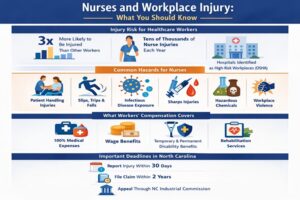
Nurses devote their careers to patient care, often working long shifts in physically demanding and high-risk environments. According to federal labor data, healthcare workers have one of the highest rates of injuries in the workplace, roughly three times more likely to experience work-related injuries than employees in many other sectors. The Occupational Safety and Health Administration (OSHA) has identified hospitals as among the most dangerous places to work due to patient handling demands, exposure to disease, and workplace violence.
If you suffer a workplace injury while performing your job duties, filing a workers’ compensation claim may protect both your health and your financial stability.
Reasons Nurses Should File a Workers’ Compensation Claim
In North Carolina, most employers are required to carry workers’ compensation insurance if they have three or more employees. Nurses and other healthcare workers who suffer job-related injuries may file a claim for workers’ compensation benefits under state law.
Below are three important reasons to consider filing a claim after a work injury.
1. Protect Your Health and Patient Safety
Common workplace hazards for nurses include slips, trips, falls, exposure to infectious diseases, overexertion, toxic chemicals, sharps injuries, and even violence from patients or visitors.
Trying to continue working while injured can place both your own health and patient care at risk. Back injuries from lifting patients, repetitive strain injuries, and needlestick injuries may worsen without proper treatment.
Workers’ compensation benefits in North Carolina cover all reasonable and necessary medical expenses related to a job injury. Eligible medical treatment may include:
- Doctor visits
- Hospital stays
- Surgeries
- Prescription medications
- Physical therapy
- Rehabilitation services
- Approved medical equipment
There is no deductible for covered treatment under the system.
Prompt medical care not only supports recovery but also helps document that the injury was work-related.
2. Protect Your Income and Financial Stability
Work injuries can create immediate financial strain. Nurses may miss work due to physical injuries, occupational disease, or emotional trauma following workplace violence.
Workers’ compensation benefits in North Carolina provide wage replacement if an injured employee is unable to work. In most cases, eligible workers receive approximately 66 2/3% of their average weekly wage, subject to a maximum weekly compensation rate. For 2026, the maximum weekly workers’ compensation rate in North Carolina is $1,380.00.
Temporary Total Disability (TTD) benefits may apply if a nurse is completely unable to work during recovery. Injured nurses may also be eligible for permanent partial or permanent total disability benefits if the injury results in lasting impairment.
Without filing a workers’ compensation claim, injured employees may lose access to this financial support while medical bills and household expenses continue.
3. The Law Provides a Clear Claim and Appeal Process
Workers’ compensation operates as a no-fault system. Nurses do not need to prove their employer was negligent, but they must show that the injury arose out of and in the course of employment. Claims must be substantiated with evidence demonstrating that the injury was work-related.
In North Carolina:
- Injured employees must notify their employer of the injury within 30 days.
- A formal workers’ compensation claim generally must be filed within two years of the injury date.
Claims are administered through the North Carolina Industrial Commission.
If a workers’ compensation claim is denied, the employee has the right to appeal. The appeals process involves requesting a hearing before the North Carolina Industrial Commission, where the claim can be reviewed and evidence presented.
Understanding these deadlines and procedures is critical to protecting your rights.
Common Workplace Hazards Nurses Face
The healthcare industry presents unique occupational risks. Healthcare workers are exposed to physical, biological, and environmental hazards that are not as common in many other professions. In fact, federal labor data consistently shows that healthcare workers experience some of the highest injury rates among all industries.
Many healthcare workers experience:
- Slips, trips, and falls
- Back injuries from patient handling
- Musculoskeletal injuries due to overexertion
- Exposure to infectious diseases
- Sharps injuries from contaminated medical equipment
- Exposure to hazardous chemicals
- Workplace violence or physical assault
These hazards often arise during routine patient care tasks.
Patient Handling and Musculoskeletal Injuries
One of the most common causes of workplace injury for nurses is lifting, transferring, or repositioning patients. Even when proper body mechanics are used, repetitive physical strain can lead to back injuries, shoulder damage, and chronic musculoskeletal injuries.
These injuries may not occur suddenly. Many develop gradually due to repeated stress over time, particularly in understaffed environments where nurses must move patients frequently.
Slips, Trips, and Falls
Hospitals and healthcare facilities are fast-moving environments. Spilled liquids, medical equipment cords, uneven flooring, and hurried movement between patient rooms can increase the risk of slips and falls.
These incidents may result in fractures, head injuries, sprains, or severe injuries requiring extended recovery.
Infectious Diseases and Sharps Injuries
Nurses and other healthcare professionals are routinely exposed to infectious diseases. Contact with blood, respiratory droplets, or contaminated medical equipment creates risk for occupational illness.
Needlestick and sharps injuries present additional danger. Even a minor puncture can expose a nurse to bloodborne pathogens, requiring testing, monitoring, and medical treatment.
Hazardous Chemicals and Environmental Exposure
In the medical field, nurses may be exposed to cleaning agents, sterilization chemicals, medications, and other hazardous substances. Repeated exposure can contribute to respiratory issues, skin conditions, or other occupational disease concerns.
Workplace Violence
Healthcare facilities also face elevated risks of workplace violence. Nurses may encounter aggressive behavior from patients experiencing medical crises, mental health episodes, or emotional distress. Physical assault remains an unfortunate but documented risk in the healthcare industry.
Registered nurses, certified nursing assistants, nursing assistants, and other healthcare professionals all face elevated risks compared to workers in many other fields. Because injuries can occur during routine patient care, it is important to recognize when an incident may qualify as a workplace injury under workers’ compensation law.
Why Reporting Injuries Matters

Promptly reporting injuries is essential. Failing to report within the required timeframe may jeopardize eligibility for benefits.
Injured employees should document:
- When and where the injury occurred
- What job duties were being performed
- Any witnesses
- Medical treatment received
Strong documentation supports a workers’ compensation case and reduces disputes with the insurance company.
What to Do If Your Workers’ Compensation Claim Is Disputed
Although the workers’ compensation system is designed to provide benefits efficiently, disputes sometimes arise regarding medical treatment approval, wage replacement calculations, or whether an injury qualifies as work-related.
If complications occur, injured nurses may consider speaking with experienced workers’ compensation attorneys to better understand their options. A knowledgeable legal team can help navigate disputes and pursue fair compensation through the appropriate channels.
Workers’ Compensation
And Family Lawyers
Providing
Strength In A
Time of Crisis
Call US now:
Our Success
Case Results
$80,000
Elbow Injury
$350,000
Arm Injury


reviews
What Real Clients Have To Say
Melissa S.

Lou and his team did an outstanding job on my case. They kept me updated constantly. There were times when I was so overwhelmed-the encouragement I received from the firm is the BEST I’ve received from any law firm in the past. I HIGHLY recommend Lou and his team.
Tim J.
Great attorney helped the most at a important time.
Aimee B.
Lou and his team worked quickly to ensure that my husband received the care and physical therapy he needed after a pretty serious work injury. They handled every phone call and question with the insurance adjuster, we didn’t have to fight with anyone to get anything that was expected or promised. They communicated with us every step of the way, and they were especially responsive and helpful when my husband’s case required more than anyone had anticipated. Every person we have spoken with in Lou’s office were patient and respectful, we never felt like we...
Lucas J.
Very good people to work with! I highly recommend this law firm.
Dustin M.
I have never had a more pleasant experience with an attorney and their paralegals in my life!!! Hands down the best law firm in North Carolina, probably the whole country! Would definitely recommend them to anyone needing counsel. They are all so easy to get along with and friendly.... My employer lied, as many do in this situation but Lou and his team were quick to step in and get me the compensation I deserved! Thank you, from my whole family. Waple and Houk are #1
Darrin R.
Mr. Lou is by far the most compassionate attorney I’ve encountered and once again he helped me with a worker’s compensation claim and his paralegal was also great. Mr.Lou is very professional and he allows you room for your concerns and opinions, he’s just a great human being that doesn’t need to advertise his partnership law firm on tv just ask any of his past clients and they would totally agree with me, God forbid that I’m in a serious car accident but if I am he’s just a phone call away so if you...
Travis B.
Mr. Waple did a fantastic job on my case, even if I wasn't a lot of help he still came through and for that I thank you Mr. Waple.
Tara D.
I was at a point of despair & thought that my then employer would do the right thing. Lou’s honesty, and integrity; along with his guidance gave me the dose of reality that I needed to see the true colors of legality in corporate America. Without his savvy I would have been blindsided! Cherie, always responded to all of my responses, and nervous reactions and made sure Lou was aware of what was happening! Great firm, I would highly recommend to anyone who wants respect, honesty and guidance as a client!
Aunyette S.
Mr.Waple has handled both of my cases very well. I definitely recommend this team of professional lawyers and secretaries. Thank you!
Tashaun H.
My experience working with Lou was an absolute joy. From our very first conversation, he assured me that he would work relentlessly to help me secure adequate compensation for my case and he did just that. His paralegal, Cheri, was helpful with timely responses to any and all questions I had and she helped reduce the stress of a very tedious process. I highly recommend this firm for any future litigation and would love to work with them again if the opportunity arises.

Request a Consultation
We Are Here For You

NUVEW | Copyright 2026 All Rights Reserved | Accessibility Notice | Privacy Policy
Attorney Advertising. This information is designed for general information only. The information presented should not be construed to be formal legal advice nor the formation of a lawyer/client relationship. Past results and testimonials are not a guarantee, warranty, or prediction of the outcome of your case, and should not be construed as such. Past results cannot guarantee future performance. Any result in a single case is not meant to create an expectation of similar results in future matters because each case involves many different factors, therefore, results will differ on a case-by-case basis. By providing contact information, users acknowledge and give explicit consent to be contacted via the methods of communication provided, including SMS. Message and data rates may apply. Message frequency may vary. Reply STOP to opt out.