
Serving All North Carolina
(704) 954-8697
Charlotte Workers’ Compensation Attorneys for Nurses
$325,000
Back Injury
$198,000
Back Injury
$170,000
Shoulder Injury
$130,000
Shoulder Injury
$125,000
Back Injury
$115,000
Back/Hip Injury
$100,000
Foot Injury
$90,000
Neck/Back Injury
$75,000
Hand Injury
$70,000
Foot Injury
Helping Injured Nurses and Healthcare Workers in North Carolina
Nurses dedicate their careers to caring for others. Yet the healthcare field carries one of the highest rates of workplace injury in North Carolina. If you are searching for a Charlotte nurses workers’ compensation attorney, you are likely dealing with an injury that has disrupted your ability to work, earn income, or care for your family.
Nurses and healthcare workers face daily exposure to lifting injuries, violent patients, infectious diseases, and physically demanding environments. When a work-related injury occurs, you have the right to pursue workers’ compensation benefits under North Carolina law.
At Waple & Houk, PLLC, our Charlotte workers’ compensation attorneys for nurses represent RNs, LPNs, CNAs, hospital staff, and healthcare professionals throughout Charlotte, Huntersville, and surrounding communities. We help injured nurses file claims, challenge denied workers’ compensation claims, and protect their right to medical care and wage replacement benefits.
Workers’ Compensation for Nurses in Charlotte
Workers’ compensation in North Carolina is a no-fault system. You do not need to prove your employer was negligent. If your injury occurred while performing your job duties, you may qualify for benefits.
Workers’ compensation benefits for nurses can include:
- Payment for medical treatment
- Coverage for hospital visits and surgery
- Payment of medical bills
- Temporary disability benefits
- Compensation for lost wages
- Long-term disability benefits in serious cases
Workers’ compensation claims in North Carolina are handled by the Industrial Commission. If your employer or the insurance company disputes your claim, you have the right to request a hearing.
North Carolina Workers’ Compensation Law for Nurses
Under the North Carolina Workers’ Compensation Act, virtually all businesses with at least three employees are required to provide workers’ compensation insurance. This includes hospitals, urgent care centers, clinics, nursing homes, and other healthcare facilities.
Workers’ compensation claims in North Carolina are overseen by the North Carolina Industrial Commission (NCIC). The Industrial Commission governs the claims process, provides required forms, and resolves disputes between injured workers and insurance companies.
Because the system is no-fault, you may still recover workers’ compensation benefits even if you were partially responsible for your injury.
Unique Risks Nurses Face in Charlotte Healthcare Facilities
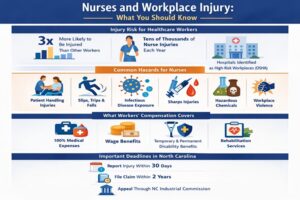
Nurses in Charlotte face injury risks that are significantly higher than many other professions. Healthcare workers are routinely exposed to hazards that are both physical and biological in nature.
Common risks include:
- Overexertion from lifting and moving patients
- Back injuries caused by patient transfers
- Musculoskeletal injuries from repetitive strain
- Slips, trips, and falls due to spills and equipment hazards
- Sharps injuries from needles and scalpels
- Exposure to infectious diseases through contaminated equipment
- Exposure to toxic chemicals that may cause respiratory illness or chemical burns
- Violence from patients or their family members
Healthcare workers may suffer both physical and emotional trauma from workplace violence. If an injury results from an assault, nurses may file for workers’ compensation benefits and, in certain circumstances, pursue a separate civil lawsuit against the aggressor.
Workers’ compensation benefits cover both sudden accidents (slips, lifts, assaults) and occupational diseases (infections, repetitive strain, respiratory conditions).
Common Nurse and Healthcare Worker Injuries
Healthcare workers experience some of the highest rates of musculoskeletal injury of any industry.
Musculoskeletal Injuries
Nurses frequently suffer back injuries, slipped discs, shoulder tears, and chronic spinal strain from lifting and repositioning patients.
Slip and Fall Injuries
Spilled fluids, crowded hallways, and rushed conditions can lead to fractures and head injuries.
Assault-Related Injuries
Violent or unstable patients can cause traumatic injuries to nurses and hospital staff.
Needle Sticks and Bloodborne Illness
Exposure to blood and bodily fluids increases the risk of infection, including Hepatitis and other serious diseases.
Repetitive Trauma Injuries
Over time, repetitive lifting, twisting, and transferring patients can result in cumulative trauma injuries.
If you are a nurse in Charlotte and suffered any of these injuries while working, you may be eligible for workers’ compensation benefits.
What To Do After a Workplace Injury as a Nurse

If you are injured while working in a hospital, clinic, or healthcare facility in Charlotte, immediate reporting is required.
Under North Carolina law:
- You must notify your supervisor immediately.
- You must submit a written report within 30 days.
- Workers’ compensation claims must be reported to the employer within 30 days to preserve your right to benefits.
- You must file Form 18 with the Industrial Commission within two years of the injury.
Failing to notify your employer both orally and in writing within 30 days can jeopardize your claim.
After reporting the injury:
- Seek medical attention as soon as possible.
- You must seek treatment from an authorized medical provider unless it is an emergency.
- Follow all medical instructions carefully.
- Keep copies of medical records and all documents related to your injury and treatment.
In Charlotte, injured nurses may be entitled to mileage reimbursement for travel to authorized medical appointments exceeding 20 miles.
The workers’ compensation process can be complicated, particularly when an insurance company disputes the claim. Early legal guidance can reduce the risk of delays or denials.
Filing a Workers’ Compensation Claim in North Carolina
To begin the formal process, you must file Form 18 with the North Carolina Industrial Commission. Your employer is required to provide the appropriate claim information once you report your injury.
Complications may arise if:
- Your employer disputes the injury
- The insurance company claims the injury is not work-related
- Benefits are suspended
- Your claim is denied
Involving a Charlotte workers’ compensation lawyer early in the process can help protect your rights and strengthen your claim.
What If My Claim Is Denied?
If you are a nurse in Charlotte and your workers’ compensation claim is denied, you have the right to request a formal appeal.
To request a hearing, you must file Form 33 – Request for Hearing with the North Carolina Industrial Commission. Your case will be heard before a deputy commissioner.
At the hearing, you must demonstrate that your injury occurred in the course of employment and that you are entitled to benefits.
An experienced Charlotte workers’ compensation attorney for nurses can:
- Gather medical evidence
- Present testimony
- Cross-examine witnesses
- Argue before the Industrial Commission
- Appeal improper denials
Workers’ compensation claims can be complex, and many denials result from procedural or documentation issues. You do not lose your rights simply because an insurance company disputes your claim.
Your Rights as a Nurse After a Work Injury
As an injured nurse in North Carolina, you may have the right to:
- Receive workers’ compensation benefits
- Continue benefits until you reach maximum medical improvement
- Appeal denied claims
- Request a formal hearing
- File a civil lawsuit against third parties when appropriate
Under North Carolina law, it is illegal for an employer to retaliate against a worker for filing a workers’ compensation claim.
If you were assaulted by a patient, criminal prosecution may occur. However, criminal charges do not replace your right to pursue compensation through workers’ compensation or, when appropriate, civil court.
How Much Does a Charlotte Workers’ Compensation Lawyer Cost?
Workers’ compensation attorneys in North Carolina operate on a contingency fee basis. Fees must be approved by the Industrial Commission and typically do not exceed 25% of the awarded amount.
You pay nothing unless compensation is recovered.
Frequently Asked Questions About Workers’ Compensation for Nurses in Charlotte
Can I receive workers’ compensation if I develop an injury over time from lifting patients?
Yes. Workers’ compensation in North Carolina covers not only sudden accidents, but also occupational injuries that develop over time. Many nurses suffer cumulative trauma injuries such as chronic back strain, shoulder tears, or repetitive stress injuries caused by years of lifting and repositioning patients. These conditions may still qualify if medical evidence connects them to your job duties.
What if my employer says my injury was a “pre-existing condition”?
Insurance companies often argue that a nurse’s back or shoulder injury was pre-existing. However, if your job duties aggravated, accelerated, or significantly worsened that condition, you may still be entitled to workers’ compensation benefits. Medical documentation is critical in these cases.
Can I choose my own doctor after a workplace injury?
In most workers’ compensation cases in North Carolina, the employer or insurance carrier selects the authorized treating physician. However, you may request a change of physician through the North Carolina Industrial Commission under certain circumstances. An attorney can help you file the proper request.
What happens if I can return to work but only in a limited capacity?
If your doctor places you on light-duty restrictions, your employer may offer modified work. If the position does not comply with your medical restrictions or does not exist, you may still qualify for partial disability benefits. Wage replacement may apply if you earn less than your pre-injury wages.
Can I receive benefits if I was injured by a violent patient?
Yes. Injuries caused by assaults from patients or family members are generally covered under workers’ compensation as long as the incident arose out of your employment. In some cases, you may also have the right to pursue a separate civil claim against the individual responsible.
What if my employer discourages me from filing a claim?
Employers cannot legally retaliate against you for filing a workers’ compensation claim. If you experience discipline, termination, or intimidation after reporting an injury, you may have additional legal protections under North Carolina law.
How long can I receive workers’ compensation benefits?
Temporary disability benefits may continue for up to 500 weeks in many cases. Permanent partial disability or total disability benefits may apply depending on the severity of your injury and your ability to return to work.
Will filing a workers’ compensation claim affect my nursing license?
No. Filing a workers’ compensation claim does not affect your professional nursing license. Workers’ compensation is an employment insurance system and does not create disciplinary consequences for seeking benefits.
Can I receive Social Security Disability and workers’ compensation at the same time?
In some cases, yes. However, benefits may be coordinated, and offsets can apply. It is important to structure settlements properly to avoid unintended reductions.
Speak With a Charlotte Workers’ Compensation Attorney for Nurses

Nurses and healthcare workers in Charlotte face some of the highest injury risks of any profession. Whether you suffered a back injury from lifting a patient, a sharps injury, an assault, or developed an occupational illness over time, North Carolina workers’ compensation law exists to protect you.
Workers’ compensation benefits can help cover medical bills and lost wages so you can focus on recovery.
At Waple & Houk, PLLC, we represent injured nurses and healthcare professionals throughout Charlotte and surrounding communities. If you are searching for a nurses workers compensation Charlotte attorney, contact our office today for a free consultation and clear guidance about your next steps.
reviews
What Real Clients Have To Say
Melissa S.

Lou and his team did an outstanding job on my case. They kept me updated constantly. There were times when I was so overwhelmed-the encouragement I received from the firm is the BEST I’ve received from any law firm in the past. I HIGHLY recommend Lou and his team.
Tim J.
Great attorney helped the most at a important time.
Aimee B.
Lou and his team worked quickly to ensure that my husband received the care and physical therapy he needed after a pretty serious work injury. They handled every phone call and question with the insurance adjuster, we didn’t have to fight with anyone to get anything that was expected or promised. They communicated with us every step of the way, and they were especially responsive and helpful when my husband’s case required more than anyone had anticipated. Every person we have spoken with in Lou’s office were patient and respectful, we never felt like we...
Lucas J.
Very good people to work with! I highly recommend this law firm.
Dustin M.
I have never had a more pleasant experience with an attorney and their paralegals in my life!!! Hands down the best law firm in North Carolina, probably the whole country! Would definitely recommend them to anyone needing counsel. They are all so easy to get along with and friendly.... My employer lied, as many do in this situation but Lou and his team were quick to step in and get me the compensation I deserved! Thank you, from my whole family. Waple and Houk are #1
Darrin R.
Mr. Lou is by far the most compassionate attorney I’ve encountered and once again he helped me with a worker’s compensation claim and his paralegal was also great. Mr.Lou is very professional and he allows you room for your concerns and opinions, he’s just a great human being that doesn’t need to advertise his partnership law firm on tv just ask any of his past clients and they would totally agree with me, God forbid that I’m in a serious car accident but if I am he’s just a phone call away so if you...
Travis B.
Mr. Waple did a fantastic job on my case, even if I wasn't a lot of help he still came through and for that I thank you Mr. Waple.
Tara D.
I was at a point of despair & thought that my then employer would do the right thing. Lou’s honesty, and integrity; along with his guidance gave me the dose of reality that I needed to see the true colors of legality in corporate America. Without his savvy I would have been blindsided! Cherie, always responded to all of my responses, and nervous reactions and made sure Lou was aware of what was happening! Great firm, I would highly recommend to anyone who wants respect, honesty and guidance as a client!
Aunyette S.
Mr.Waple has handled both of my cases very well. I definitely recommend this team of professional lawyers and secretaries. Thank you!
Tashaun H.
My experience working with Lou was an absolute joy. From our very first conversation, he assured me that he would work relentlessly to help me secure adequate compensation for my case and he did just that. His paralegal, Cheri, was helpful with timely responses to any and all questions I had and she helped reduce the stress of a very tedious process. I highly recommend this firm for any future litigation and would love to work with them again if the opportunity arises.

Request a Consultation
We Are Here For You

NUVEW | Copyright 2026 All Rights Reserved | Accessibility Notice | Privacy Policy
Attorney Advertising. This information is designed for general information only. The information presented should not be construed to be formal legal advice nor the formation of a lawyer/client relationship. Past results and testimonials are not a guarantee, warranty, or prediction of the outcome of your case, and should not be construed as such. Past results cannot guarantee future performance. Any result in a single case is not meant to create an expectation of similar results in future matters because each case involves many different factors, therefore, results will differ on a case-by-case basis. By providing contact information, users acknowledge and give explicit consent to be contacted via the methods of communication provided, including SMS. Message and data rates may apply. Message frequency may vary. Reply STOP to opt out.