Serving All North Carolina
(704) 954-8697
Can You Receive Workers’ Comp if You’re Paid in Cash?
Connect With Us
19Jun
Most employers today pay workers through direct deposit or payroll checks, but not every job follows that model. Some workers are paid in cash, and that alone does not make the employment relationship any less legitimate. If you are injured on the job, the method your employer used to pay you is only one piece of the picture. Your eligibility for workers’ compensation depends on factors such as your employment status, your employer’s legal obligations, and the facts surrounding your injury. Reach out to a Worker’s compensation lawyer today.
How Workers’ Compensation Coverage Actually Works

North Carolina requires most employers to carry workers’ compensation insurance if they have three or more employees. Coverage is not tied to how wages are paid. It is tied to the employment relationship. A worker who is genuinely an employee under North Carolina law is entitled to workers’ compensation benefits regardless of whether their wages were paid by check, direct deposit, or cash.
The legal analysis begins with whether the injured person is an employee or an independent contractor, and it does not end with what label the employer used. Employers sometimes classify workers as independent contractors to avoid payroll taxes, benefits, and workers’ compensation obligations. North Carolina courts and the Industrial Commission look past the label and examine the actual working relationship to determine the correct classification.
According to the North Carolina Department of Labor, workers’ compensation coverage applies to nearly all employees in the state, with limited exceptions for domestic servants, certain agricultural workers, and other specifically excluded categories. Most workers in construction, manufacturing, food service, landscaping, and similar industries where cash payment is common fall under covered employment.
Employee vs. Independent Contractor: The Threshold Question

The distinction between an employee and an independent contractor determines workers’ compensation eligibility more than any other factor. North Carolina uses a multi-factor test to evaluate this question, and the label an employer assigns is not controlling.
Factors the North Carolina Industrial Commission considers include:
- Whether the employer controls not just the outcome of the work but also how the work is performed
- Whether the worker provides their own tools and equipment
- Whether the worker performs services for multiple employers or works exclusively for one
- Whether the work is part of the employer’s regular business
- Whether the employer sets the hours and location of work
- Whether there is a continuing relationship or a project-based one
- How the parties understood their relationship
A worker who is told they are an independent contractor but who shows up to the same job site every day, uses the employer’s tools, works under the employer’s supervision, and performs work that is central to the employer’s business is likely an employee under this analysis, regardless of what the contract says or how they were paid.
Many employers in cash-heavy industries misclassify workers deliberately, knowing it reduces costs. A cash payment arrangement that also lacks any formal contract, any tax documentation, or any independent contractor agreement is often the hallmark of misclassification rather than genuine independent contractor status. That misclassification does not eliminate workers’ compensation rights. In some cases, it creates additional liability for the employer.
The Challenge of Proving Income in a Cash Payment Claim
If the employment relationship qualifies for coverage, the next challenge is calculating the benefit. Workers’ compensation wage replacement benefits in North Carolina are based on the average weekly wage, which equals two-thirds of the worker’s pre-injury earnings, subject to the state maximum. For a cash payment workers’ comp claim, establishing what those earnings actually were is often the most contested issue.
Workers’ compensation income replacement is calculated from documented wages. When wages have been paid in cash and no payroll records exist, proving what a worker actually earned requires gathering alternative evidence.

Evidence That Can Support a Cash Wage Workers’ Comp Claim
- Bank records showing regular cash deposits consistent with the claimed wages
- Text messages or emails between the worker and employer discussing pay rates or hours
- Personal records kept by the worker, including notebooks or calendars tracking hours and pay received
- Testimony from co-workers who can speak to the worker’s hours and the employer’s pay practices
- Social media or other records showing the worker at the job site on specific dates
- Any receipts, invoices, or written records of cash payments that were made
- Tax filings if the worker reported cash income on prior year returns
The absence of formal payroll records hurts a cash wage claim, but it does not defeat it. The Industrial Commission can consider all relevant evidence, and workers who have corroborating documentation, even informal documentation, are in a stronger position than those who have none at all.
What Happens When an Employer Denies an Employment Relationship
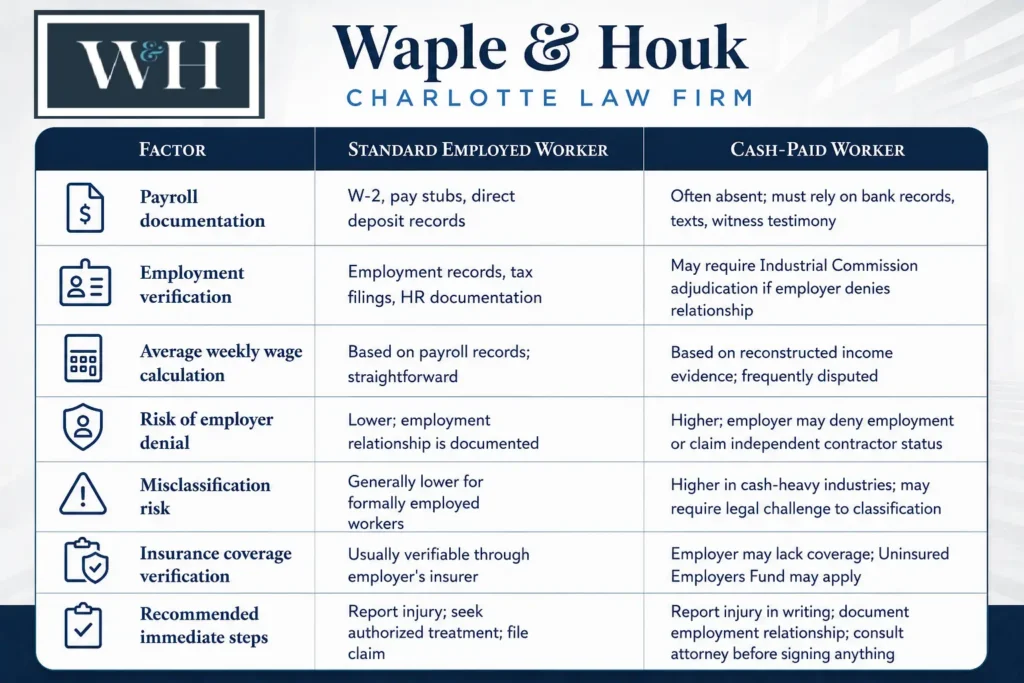
One of the most difficult situations for a cash-paid worker is when the employer denies that any employment relationship existed at all. This is more common than it should be, and it is particularly challenging in industries like construction, where cash labor is frequently used, and informal hiring arrangements are common in the Charlotte area and statewide.
When an employer denies the relationship, the claim becomes a dispute that the North Carolina Industrial Commission adjudicates. The worker must present evidence establishing that they were, in fact, an employee. The burden of proof is on the worker at that stage, and the strength of the available evidence determines whether the claim succeeds.
This is the situation where workers frequently need workers’ compensation representation. Building a record of the employment relationship, navigating the Industrial Commission process, and presenting the wage evidence effectively requires familiarity with how these disputes are evaluated. A worker trying to navigate this alone while also recovering from an injury faces a significant disadvantage.
What To Do After an Injury If You Are Paid in Cash

The steps a cash payment workers’ comp claimant takes immediately after an injury affect the strength of their claim significantly. The priority is always medical attention. After that, the documentation process is what separates claims that succeed from those that do not.
- Report the injury to the employer immediately and do so in writing if possible. A text message creating a record of the report is better than a verbal conversation with no documentation.
- Seek medical treatment and be accurate with healthcare providers about how the injury occurred and that it happened at work. Medical records that describe a work injury are important evidence.
- Write down what you remember about the circumstances of employment: how long you worked there, what you were paid, when you were paid, and who paid you.
- Identify co-workers who can speak to the working conditions and the employment arrangement.
- Do not sign anything the employer or their insurer presents without understanding what it says. Cash-paid workers are sometimes pressured to sign statements characterizing themselves as independent contractors after an injury.
That last point is the practical warning that matters most in this situation. An employer facing a workers’ compensation claim has an incentive to characterize the injured worker as an independent contractor. A worker who signs a statement to that effect, particularly under the stress of an injury, may significantly harm their own claim. Getting legal advice before signing anything is worth the time it takes.
When the Employer Does Not Have Insurance

In some cases, a worker entitled to workers’ compensation discovers that their employer does not carry the required insurance. North Carolina requires most employers to carry this coverage, but not all comply. When an employer lacks required workers’ compensation insurance, the injured worker is not without options.
The North Carolina Industrial Commission maintains an Uninsured Employers Fund that can provide benefits to workers injured by employers who are required to carry coverage but did not. The process for accessing this fund is different from a standard workers’ compensation claim, but it exists specifically to protect workers in this situation.
Additionally, an employer who fails to carry required workers’ compensation insurance loses the protection that workers’ compensation provides against personal injury lawsuits. An injured worker in that situation may have a direct negligence claim against the employer, with the ability to recover damages that go beyond what workers’ compensation would have provided.
The Employment Relationship Is What the Law Protects

Workers who are paid in cash often assume they have no legal protection after an injury. That assumption is understandable given the informal nature of the arrangement, but it is frequently wrong. North Carolina’s workers’ compensation system is designed to cover workers based on the employment relationship, not on the paperwork that surrounds it. When a worker performs labor under an employer’s control, at an employer’s direction, using an employer’s materials, the law typically views that as employment regardless of whether taxes were withheld or wages were paid by check.
The practical reality is that proving these claims requires more effort than a standard workers’ compensation case with clear payroll records. That additional effort is not a reason to abandon a legitimate claim. It is a reason to approach the process with the documentation and legal support that makes the difference between a denied claim and a successful one.
For workers in the Charlotte area who were injured on the job and believe they may be entitled to benefits despite being paid in cash, understanding the legal landscape accurately is the starting point. The law provides more protection than many cash-paid workers realize, and knowing that changes what steps are worth taking.
Workers’ Compensation
And Family Lawyers
Providing
Strength In A
Time of Crisis
Call US now:
Our Success
Case Results
$80,000
Elbow Injury
$350,000
Arm Injury






Related Posts


reviews
What Real Clients Have To Say
Melissa S.

Lou and his team did an outstanding job on my case. They kept me updated constantly. There were times when I was so overwhelmed-the encouragement I received from the firm is the BEST I’ve received from any law firm in the past. I HIGHLY recommend Lou and his team.
Tim J.
Great attorney helped the most at a important time.
Aimee B.
Lou and his team worked quickly to ensure that my husband received the care and physical therapy he needed after a pretty serious work injury. They handled every phone call and question with the insurance adjuster, we didn’t have to fight with anyone to get anything that was expected or promised. They communicated with us every step of the way, and they were especially responsive and helpful when my husband’s case required more than anyone had anticipated. Every person we have spoken with in Lou’s office were patient and respectful, we never felt like we...
Lucas J.
Very good people to work with! I highly recommend this law firm.
Dustin M.
I have never had a more pleasant experience with an attorney and their paralegals in my life!!! Hands down the best law firm in North Carolina, probably the whole country! Would definitely recommend them to anyone needing counsel. They are all so easy to get along with and friendly.... My employer lied, as many do in this situation but Lou and his team were quick to step in and get me the compensation I deserved! Thank you, from my whole family. Waple and Houk are #1
Darrin R.
Mr. Lou is by far the most compassionate attorney I’ve encountered and once again he helped me with a worker’s compensation claim and his paralegal was also great. Mr.Lou is very professional and he allows you room for your concerns and opinions, he’s just a great human being that doesn’t need to advertise his partnership law firm on tv just ask any of his past clients and they would totally agree with me, God forbid that I’m in a serious car accident but if I am he’s just a phone call away so if you...
Travis B.
Mr. Waple did a fantastic job on my case, even if I wasn't a lot of help he still came through and for that I thank you Mr. Waple.
Tara D.
I was at a point of despair & thought that my then employer would do the right thing. Lou’s honesty, and integrity; along with his guidance gave me the dose of reality that I needed to see the true colors of legality in corporate America. Without his savvy I would have been blindsided! Cherie, always responded to all of my responses, and nervous reactions and made sure Lou was aware of what was happening! Great firm, I would highly recommend to anyone who wants respect, honesty and guidance as a client!
Aunyette S.
Mr.Waple has handled both of my cases very well. I definitely recommend this team of professional lawyers and secretaries. Thank you!
Tashaun H.
My experience working with Lou was an absolute joy. From our very first conversation, he assured me that he would work relentlessly to help me secure adequate compensation for my case and he did just that. His paralegal, Cheri, was helpful with timely responses to any and all questions I had and she helped reduce the stress of a very tedious process. I highly recommend this firm for any future litigation and would love to work with them again if the opportunity arises.